

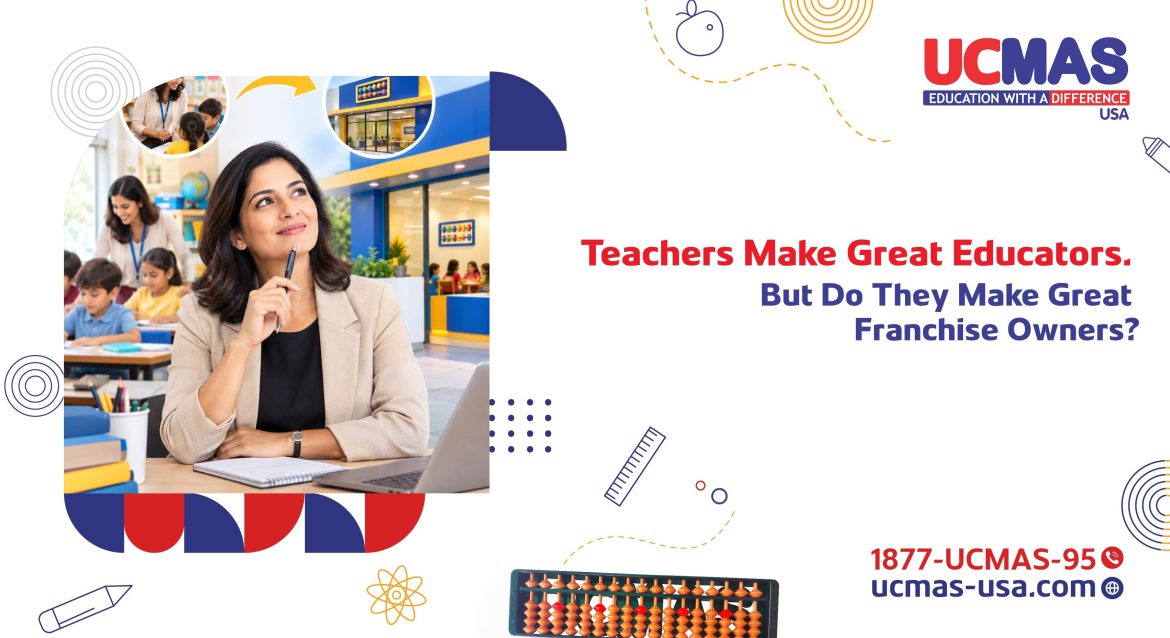
Teaching gives you something most first-time entrepreneurs spend years trying to understand: people.
You know how children learn. You have dealt with worried parents, different personalities, changing schedules, competing priorities and unexpected problems, often before lunchtime. So, when you leave teaching and begin considering your next professional move, starting completely outside education may not be your only option.
For some former educators, the more natural career transition may be moving from delivering education to building an education business.
UCMAS offers another way to former educators to remain connected to children’s development while stepping into entrepreneurship. Its franchise model includes a structured curriculum, training and ongoing support for owners.
So, is a franchise for former teachers actually a good idea? More importantly, are the skills that made you effective in the classroom enough to help you succeed as a business owner? Let’s find out.
Why Former Teachers May Have an Entrepreneurial Head Start
Teacher entrepreneurship might sound like a significant professional shift, but the two worlds have more in common than you might initially think.
Teachers already make dozens of decisions every day. They manage time, people and resources. They explain ideas, solve problems, respond to feedback and adapt when something is not working.
These are transferable skills.
Consider what happens in a classroom. You have to keep students engaged, communicate expectations, monitor performance and build relationships with families. In a franchise, the setting changes, but many of those responsibilities remain.
Instead of managing a class, you may manage employees. Instead of planning lessons, you may plan enrollment campaigns. Instead of discussing a student’s progress during a parent conference, you may be building long-term relationships with families at your center.
Your classroom experience does not automatically make you an entrepreneur. It does, however, mean you may be starting with more relevant experience than you realize.
From Teaching to Entrepreneurship: What Actually Changes?

The biggest change is responsibility.
As a teacher, you work within a larger educational system. As a franchise owner, you become responsible for the performance of your own center.
That means moving from teaching to entrepreneurship requires you to think beyond academic outcomes. You have to consider enrollment, staffing, marketing, expenses, customer experience and long-term growth.
This is why an education business for educators can be attractive compared with starting an independent business from scratch. With a franchise, the curriculum, brand and operating framework have already been developed.
The UCMAS franchising model provides franchisees with curriculum, training and ongoing support. It also offers different franchise structures, including single-unit and multi-unit opportunities.
You still have to operate and grow the business. The difference is that you are not designing every component from zero.
The Teacher Skills That Translate Surprisingly Well to Business
Some of the strongest skills teachers bring into an education franchise for teachers are not subject-specific at all.
- Communication: Teachers spend years explaining information clearly to students, parents and colleagues. Strong parent communication is particularly valuable in children’s enrichment businesses, where trust can influence enrollment and retention.
- Student engagement: Teachers understand that simply presenting information does not guarantee attention. Knowing how children respond to encouragement, challenges and different learning styles can help an owner evaluate the experience being delivered at their center.
- Organization: Lesson plans, assessments, meetings, deadlines and administrative work require serious time management. Those habits can transfer naturally into education management.
- Leadership: Teachers set expectations and create environments in which people can perform well. As an owner, that ability becomes valuable when hiring, training and managing instructors.
- Problem-solving: A classroom rarely follows the plan perfectly. Business rarely does either. Teachers accustomed to adapting quickly may find that ability particularly useful in ownership.
But Being a Great Teacher Does Not Automatically Make You a Great Owner
This distinction matters.
Running an early education franchise or children’s enrichment center involves skills that may not have been part of your teaching career.
You may need to understand budgets, leases, payroll, local marketing, hiring, enrollment targets and business performance. You also have to become comfortable selling your program. For educators who have spent their careers focused primarily on learning outcomes, the commercial side of the role can take adjustment.
Before investing, ask yourself whether you genuinely want business ownership or simply want another way to teach.
Those are different goals.
If you love teaching but dislike managing people, finances or marketing, ownership may not be your ideal next step. If you want greater control over your career and are willing to learn the business side of education, franchise opportunities for teachers may deserve serious consideration.
Do You Have to Teach Every Class Yourself?
No. Owning an education franchise and personally delivering every class are not necessarily the same job.
At UCMAS, a franchise owner’s role is one that can include center operations, enrollment, marketing and team management, while trained instructors can handle classroom delivery. Its teacher certification pathway also allows franchisees to train instructors in the UCMAS methodology.
That distinction can be particularly important for former teachers.
You may begin with hands-on involvement because you enjoy working with students. As enrollment grows, however, your time may be better spent developing partnerships, supporting staff, talking with parents and expanding the business.
Interestingly, teaching experience is not mandatory either. UCMAS explains in its guide to owning an education franchise without teaching experience that franchise ownership and classroom instruction require different skill sets.
For former educators, teaching knowledge is therefore an advantage rather than the entire job description.
How a Franchise System Can Make the Transition Easier
One of the intimidating parts of starting a business is realizing how many things you do not know yet.
A franchise can reduce some of that uncertainty by giving owners an established path to follow.
The UCMAS franchise process moves prospective owners through discovery, application, approval, territory selection, training, center setup and launch. The company states that no teaching degree is required and provides onboarding before opening.
Its franchise training and support program covers areas including curriculum delivery, operations, enrollment, marketing, technology and instructor training, with continued coaching available after launch.
For someone who knows education but not entrepreneurship, this kind of franchise training can help bridge the knowledge gap.
Look at the Numbers, Not Just the Mission
Teachers are often drawn to education because they want meaningful work. That sense of purpose can remain a major reason to consider an education franchise.
But purpose cannot replace due diligence.
Before investing, understand the initial franchise fee, setup expenses, recurring fees, working capital requirements and operating costs. You also need to assess local demographics, competition, rental costs and realistic enrollment potential.
UCMAS provides a dedicated franchise investment guide outlining the main cost categories prospective owners should consider. Exact investment figures depend on the territory and center and are provided through the franchise disclosure process.
Do not buy a franchise simply because education feels familiar. Buy one only if the model, finances, territory, responsibilities and long-term opportunity make sense for you.
So, Should a Former Teacher Buy an Education Franchise?
For the right person, it can be a compelling next chapter.
Former teachers already understand the people at the heart of the business: children and parents. They know what a positive learning environment looks like and understand how trust is built over time.
What they need to learn is how to turn those strengths into a sustainable operation.
That is where an established franchise system can be useful. Instead of abandoning years of educational experience, you can potentially apply it differently: not only helping the students in your classroom, but building a center capable of reaching many more families.
With UCMAS, former educators can explore a business model centered on children’s mental math and cognitive skill development while gaining access to an established curriculum and franchise infrastructure.
The question, then, may not be whether you are ready to stop being a teacher.
It may be whether you are ready to use everything you know in a completely different way.
If you are a former teacher considering an education business, request for UCMAS franchise information to learn more about available opportunities, investment requirements and the steps involved.
Frequently Asked Questions
It can be a strong option because teachers already understand students, parents and learning environments. Success still requires developing business, marketing, financial and management skills.
Communication, organization, leadership, problem-solving, relationship building and managing different personalities can all transfer effectively from teaching to franchise ownership.
Not necessarily. UCMAS, for example, states that prospective owners do not need a teaching degree because training and structured operational support are provided.
Yes. Former teachers can apply their educational and people-management experience while learning the financial, marketing and operational aspects of running a center.
Programs involving children’s enrichment, tutoring, STEM, math or skill development may align naturally with an educator’s experience. The right choice ultimately depends on the franchise model, market demand, investment and owner’s interests.
Yes. Depending on the franchise model, trained instructors can deliver classes while the owner concentrates on staffing, enrollment, operations, parent relationships and growth.
Training varies by brand. UCMAS provides training covering curriculum, center operations, enrollment, marketing, technology and instructor development, along with ongoing support.
It can be, particularly for teachers who want to remain in education while pursuing entrepreneurship. Prospective owners should still evaluate the investment, local market, franchise agreement and responsibilities before committing.