

In today’s digital-first world, children are growing up surrounded by calculators, smartphones, and voice assistants that can solve math problems in seconds. While technology is helpful, it has also raised an important question for parents and educators alike: Is mental math still important for kids?
The answer is a resounding yes! Mental math plays a vital role in both academic success and overall cognitive development. It lays a strong foundation for effective learning, particularly during the critical years between the ages of 5 and 13.
Mental math is more than just quick calculations done mentally. It is a powerful brain-building tool that strengthens memory, improves concentration, enhances logical thinking, and builds confidence. During the formative years of childhood, mental math plays a crucial role in shaping how children think, learn, and solve problems, not just in math, but across all areas of life.
Let’s understand the importance of mental math for kids aged 5–13, how it supports cognitive development during their formative years, the key benefits it offers, and how parents can help children practice mental math effectively.
Mental Math and Child Development
Mental math directly supports a child’s overall cognitive development. When children solve math problems mentally, they activate multiple areas of the brain at the same time. They must listen carefully, visualize numbers, remember steps, apply logic, and arrive at an answer, all without external aids.
Unlike written math, which often focuses on following steps, mental math encourages critical thinking and a deeper understanding. Children learn why a calculation works, not just how to do it. This deep understanding strengthens neural connections and improves brain flexibility.
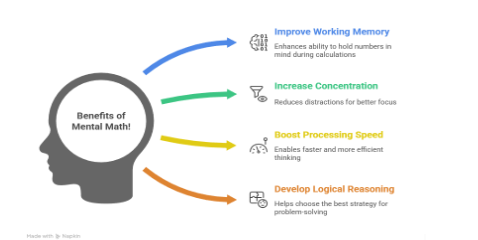
Research and classroom observations consistently show that children who regularly practice mental math tend to grasp new concepts more quickly and show greater confidence when solving problems. These cognitive skills extend beyond mathematics and support learning in science, language, coding, and even creative thinking.
The Formation Years
Why Ages 5–13 Matter Most
The age group of 5 to 13 years is often referred to as the child’s formative or foundational years. During this period, the brain is highly adaptable and responsive to learning experiences. Habits formed at this stage often last a lifetime.
Ages 5–7: Building the Foundation
At this stage, children are learning basic number concepts, including counting, number recognition, and simple addition and subtraction. Mental math helps make numbers feel friendly and approachable. Through oral counting, number games, and simple calculations, children develop a strong number sense.
When introduced playfully, mental math at this age builds curiosity rather than fear. It helps children see math as something fun and engaging, not intimidating.
Ages 8–10: Strengthening Understanding
Between ages 8 and 10, children begin working with larger numbers and more complex operations such as multiplication and division. Mental math helps them understand patterns, relationships between numbers, and shortcuts that make calculations easier.
This is also the age when children start comparing themselves to peers academically. Mental math gives them an edge, helping them understand concepts and answer questions faster and with greater confidence.
Ages 11–13: Preparing for Advanced Learning
As children approach their teenage years, math becomes more abstract with the introduction of fractions, decimals, percentages, and early algebra. Mental math supports quicker comprehension and reduces dependence on calculators.
Strong mental math skills at this stage prepare children for higher-level math, competitive exams, and real-world problem-solving. More importantly, it builds confidence at a time when academic pressure often increases.

Mental Math Benefits for Kids
Now that we understand the important role mental math plays during your child’s foundational years, let’s explore how it supports and strengthens their cognitive development, too.
1. Builds a Strong Understanding of Numbers
Mental math helps children truly understand how numbers work and connect. Instead of relying on memorized formulas, kids learn to break numbers apart and work with them flexibly. This deeper understanding leads to fewer mistakes and greater accuracy.
2. Improves Concentration and Focus
Solving problems mentally requires full attention. Children must listen carefully, remember numbers, and think through steps without distractions. With regular practice, this sharpens their focus and improves their attention span, not just in math, but in all subjects.
3. Strengthens Memory Skills
Mental math boosts both short-term and long-term memory. Children learn to hold numbers in their minds, recall math facts quickly, and apply strategies efficiently. These memory skills support overall learning and academic success.
4. Increases Speed and Accuracy
Regular mental math practice helps children solve problems faster and more accurately. This speed becomes especially useful during school exams and competitive tests, where managing time is just as important as knowing the answer.
5. Builds Confidence and Reduces Math Fear
Many children feel anxious about math. Mental math shows them that they can solve problems on their own, boosting confidence. As children experience success, fear and hesitation are replaced with self-belief and a positive attitude toward math.

6. Improves Performance Across Subjects
The thinking skills developed through mental math—logical thinking, analysis, and reasoning—extend beyond mathematics. Children often perform better in science, coding, economics, and even language learning because they learn how to think clearly and logically.
7. Encourages Everyday Problem-Solving
Mental math is a practical life skill. Whether calculating change at a shop, estimating time, or dividing items equally, children use mental math in daily situations. This builds independence, quick decision-making, and real-world confidence.
Lay the Foundation for Your Child’s Success with UCMAS USA
Mental math is far more than a classroom skill; it is a life skill that shapes how children think, learn, and approach challenges. When children develop mental math skills early, they move beyond rote learning and begin to truly understand numbers. They think faster, focus better, and approach learning with confidence rather than fear. These benefits extend across subjects and stay with them well into adulthood.
This is where UCMAS USA plays a powerful role. UCMAS is designed to nurture young minds during their foundational years through structured mental math training that enhances brain development, concentration, and analytical thinking. By engaging both sides of the brain, UCMAS helps children build strong academic foundations while developing life skills that go far beyond mathematics.
The UCMAS mental math program is an investment in your child’s future. It lays the groundwork for sharper thinking, stronger confidence, and lifelong learning success, starting right where it matters most. Enrol now!
FAQs
The key is consistency and fun. Mental math works best when practiced regularly in short, enjoyable sessions. It doesn’t require long study hours or complex tools—just daily exposure in a stress-free environment.
You can easily include mental math in everyday activities. Ask your child to add prices while shopping, count ingredients while cooking, or divide portions during meals. These real-life situations help children understand how math is used outside the classroom.
Yes, absolutely. Number-based games, board games, card games, and puzzles improve calculation speed, logical thinking, and problem-solving skills. Games make learning enjoyable and keep children engaged without putting pressure on them.
Oral quizzes and quick-fire questions help children think faster and calculate mentally. These short challenges improve speed, accuracy, and confidence—especially when done in a playful, encouraging way.
Short and well-planned daily practice sessions are more effective than long, occasional ones and help children improve steadily without feeling overwhelmed.
Yes. Age-appropriate math worksheets provide structured practice and help reinforce concepts such as addition, subtraction, multiplication, and number patterns. Worksheets also help parents track progress and identify areas where extra support is needed.
Download Practice Worksheets for your child!
Yes. Worksheets can also be combined with guided mental math programs, activities, and games. This balanced approach helps children progress systematically while keeping learning enjoyable and effective.
By keeping practice fun, offering encouragement, and celebrating progress. A supportive and pressure-free environment helps children enjoy mental math and builds skills that benefit them for life.