

As a parent, few things are more baffling than a child who is clearly bright but brings home a report card filled with “careless errors” or comments about “not reaching their full potential.” We often assume that if a child is intelligent, success should be automatic.
The reality? Intelligence is the engine, but cognitive skills are the steering wheel. Without the ability to focus, process information at speed, and mentally organize tasks, even the smartest engine can stall. This is where the shift from content-based learning to skill-based learning for kids becomes a game-changer.
Programs like UCMAS focus on building these core cognitive abilities early—helping children not just learn better, but think better.
If you’re wondering why some bright children still struggle to perform consistently, this blog breaks it down. We’ll explore the gap between school math and mental math, the science behind brain-based learning, how abacus training builds essential life skills, and why choosing the right program can shape your child’s long-term academic success.

Why Smart Kids Struggle with Focus & Speed
“He’s so smart, but he takes forever to finish his homework.” Sound familiar?
High intelligence often allows children to “coast” through early grades. However, as the workload increases, they hit a wall. Without trained concentration and processing speed, their minds begin to wander, or they become overwhelmed by multi-step instructions. They aren’t “slow”; they just haven’t been taught how to manage their mental energy efficiently.
The Gap Between School Math & Mental Math
School math focuses on the how (the formula) and the what (the answer). While essential, it often neglects the deeper layer—how the brain processes numbers.
In a typical classroom, children are trained to follow steps: write the numbers, apply the formula, and arrive at the answer. This works—but only as long as the child has access to external tools like paper, calculators, or enough time to think through each step.
Mental math, on the other hand, builds internal processing power.
- School Math: Relies on external tools—pen, paper, or calculators.
- Mental Math (The UCMAS Way): Builds an internal “mental map.”
When a child learns through abacus training, they begin to visualize numbers. Instead of solving math step-by-step externally, they compute internally—faster, more accurately, and with far greater confidence.
This gap becomes very obvious as children grow older. Those who rely only on school methods often slow down under pressure, while those trained in mental math develop:
- Faster problem-solving ability
- Strong number sense
- Reduced math anxiety
Over time, this isn’t just about math—it’s about how efficiently a child’s brain works across subjects.
Intelligence vs. Cognitive Training: A Comparison
Feature | Traditional Academic Tutoring | Skill-Based Learning (UCMAS) |
Primary Goal | Fixing a specific grade or subject | Strengthening the brain’s “processing power” |
Method | Rote memorization and repetition | Tactile, visual, and auditory stimulation |
Brain Impact | Focuses on the “Logical” Left Brain | Whole-Brain Development (Left & Right) |
Long-Term ROI | Temporary grade boost | Lifelong improvement in focus, memory, and logic |
The Science: Brain-Based Education
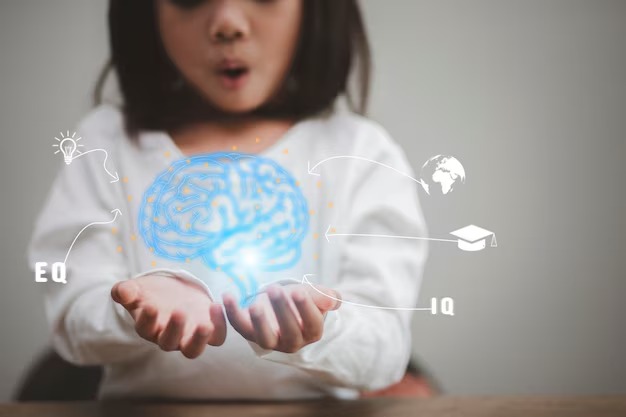
The human brain is most adaptable during early childhood—especially between ages 5 and 13. This is when neural pathways are forming rapidly, and the brain is highly responsive to structured stimulation.
This concept is rooted in neuroplasticity—the brain’s ability to reorganize itself by forming new neural connections. The more we challenge the brain in meaningful ways, the stronger and more efficient these connections become.
Abacus training is not just about numbers—it is a scientifically aligned brain exercise.
At UCMAS USA, children engage both hemispheres of the brain:
- The left brain handles logic and calculations
- The right brain visualizes the abacus and processes imagery
This dual engagement strengthens:
- Concentration span
- Working memory
- Processing speed
- Visual-spatial intelligence
Think of it like this: instead of just adding more “data” to the brain, abacus training improves the brain’s ability to handle and process that data efficiently. It’s not just learning more—it’s learning smarter.
How Abacus Training Builds the "Success Trifecta"
At UCMAS, the abacus is more than a tool—it’s a mental gym designed to build three foundational skills every child needs.
- Focus
To move beads accurately at high speed, a child must develop intense concentration. Over time, this translates into better classroom attention, improved listening skills, and the ability to stay engaged for longer periods. - Memory
As children progress, they stop using the physical abacus and begin visualizing it mentally. This strengthens their ability to retain and recall information—whether it’s formulas, vocabulary, or instructions. - Confidence
There’s a visible shift when a child realizes they can solve complex calculations mentally—and often faster than a calculator. This builds a deep sense of self-belief. That confidence doesn’t stay limited to math—it carries into academics, communication, and decision-making.
Together, these three skills form what we call the “Success Trifecta.”
And unlike short-term academic fixes, these are lifelong advantages.
The Long-Term Academic Impact of Choosing UCMAS
The goal of abacus training is not to create human calculators—it’s to build high-performing learners.
Children trained through UCMAS USA consistently demonstrate long-term academic advantages such as:
- Calm Under Pressure: They approach exams with clarity instead of panic
- High Accuracy: Improved focus helps them avoid careless mistakes
- Faster Completion: Tasks are completed efficiently, freeing up time for other activities
- Stronger Learning Ability: Better memory and concentration improve performance across subjects—not just math
- Higher Confidence Levels: They participate more actively in class and take initiative
This is where UCMAS stands apart. It doesn’t just support academic success—it builds the cognitive foundation behind that success.
Give Your Child the Advantage They Deserve
Intelligence is a gift, but skill is a choice. And the difference between the two often determines whether a child simply performs—or truly excels.
Choosing a program like UCMAS means investing in your child’s ability to think, focus, and grow with confidence. It’s not about pushing them harder—it’s about equipping them better.
If you want your child to move from “capable” to “consistently exceptional,” now is the time to act. Give your child a head start with structured cognitive training that delivers real, measurable results.
Book an information session with UCMAS today
Because the right foundation today creates limitless possibilities tomorrow.
Frequently Asked Questions (FAQs)
Often, it’s not a lack of intelligence but a gap in “Executive Function” skills like focus, organization, and processing speed. As school becomes harder, these “missing gears” make it difficult to keep up.
Unlike traditional learning, which focuses on information, skill-based learning focuses on ability. It trains the brain to think faster, remember more, and concentrate longer.
Cognitive training, such as the UCMAS abacus method, is one of the most effective ways to improve concentration in kids. It requires sustained mental effort and visualization, which strengthens the “attention muscle” over time.
Yes. Research shows that abacus training stimulates both the left (logical) and right (creative/visual) hemispheres of the brain, leading to better spatial reasoning and a higher capacity for mental tasks.