

In today’s digital-first world, parents are spoilt for choice when it comes to helping children learn math. From colorful mobile apps to time-tested tools like the abacus, the options are endless. But when the goal goes beyond just solving sums and focuses on building strong brain skills, which approach truly delivers better results?
Let’s break down Abacus vs Math Apps and see how each impacts a child’s cognitive development.
Understanding the Abacus Method
The abacus is far more than a counting frame; it is a powerful brain-development tool that has been used for centuries to build strong numerical foundations. What makes the abacus unique is the way it combines physical movement, visual imagery, and mental processing into a single learning experience.
In the early stages, children work with a physical abacus, moving beads using both hands. This two-handed activity activates both hemispheres of the brain simultaneously; the left brain, responsible for logic and numbers, and the right brain, which handles imagination and visualization. Unlike passive learning methods, the abacus requires children to actively engage, think, and respond, creating stronger neural connections.

As children advance, the learning shifts from the physical to the mental. They begin to visualize the abacus in their minds, performing calculations by imagining bead movements without touching the tool. This transition to mental abacus is where true cognitive development takes place. Children learn to hold numbers in their mind, manipulate them mentally, and arrive at accurate answers with remarkable speed.
This structured progression strengthens several critical brain skills, such as
- Concentration and focus: Abacus calculations demand sustained attention, helping children develop longer focus spans.
- Memory and recall: Children learn to store and retrieve numerical information quickly, improving both short-term and working memory.
- Speed and accuracy: Repeated mental practice trains the brain to process information faster while maintaining precision.
- Visualization skills: Imagining bead movements sharpens mental imagery, a skill linked to creativity and problem-solving.
- Left and right brain coordination: The balanced use of logic and imagination enhances overall cognitive flexibility.
Over time, the benefits of abacus learning extend far beyond mathematics. Children become quicker thinkers, better problem solvers, and more confident learners. They don’t just calculate faster; they develop the ability to process information efficiently, make decisions swiftly, and approach challenges with clarity and confidence. In essence, the abacus trains the brain how to think, not just how to count.

How Math Apps Work
Math apps are built to make mathematics feel less intimidating and more enjoyable, especially for young learners. By combining bright visuals, animations, sound effects, and rewards, these apps turn learning into a game-like experience. Children are encouraged to participate through points, levels, badges, or virtual prizes, which can boost motivation and keep them engaged in the short term.
Most math apps follow a stimulus–response model. A question appears on the screen, the child selects or taps an answer, and instant feedback is provided—right or wrong. This immediate response helps children quickly understand basic concepts such as counting, addition, subtraction, and number recognition.
Typically, math apps support learning in the following ways:
- Reinforcing basic concepts: Apps are effective for introducing and revising foundational math skills, especially in early learning stages.
- Practice through repetition: Repeated drills help children become familiar with numbers and operations, improving basic fluency.
- Short-term engagement: Game mechanics and rewards keep children interested for brief learning sessions.
- Convenience and flexibility: Apps can be used anytime, anywhere, making them appealing for busy schedules and on-the-go learning.
However, while math apps are engaging, they often rely heavily on tapping, guessing, or recognizing visual patterns rather than active mental calculation. Many problems can be solved by elimination or trial-and-error, which limits deeper thinking. Because answers are visually presented, children may depend on cues rather than truly understanding or visualizing the math behind the problem.
Additionally, app-based learning usually encourages short attention spans, as children move quickly from one task to the next. This can reduce opportunities for sustained focus, memory building, or mental visualization—key elements of strong cognitive development.
In a comparison between digital apps vs abacus, digital math apps are useful as support tools for practice and reinforcement, but on their own, they may fall short in developing long-term brain skills such as concentration, mental agility, and problem-solving depth.
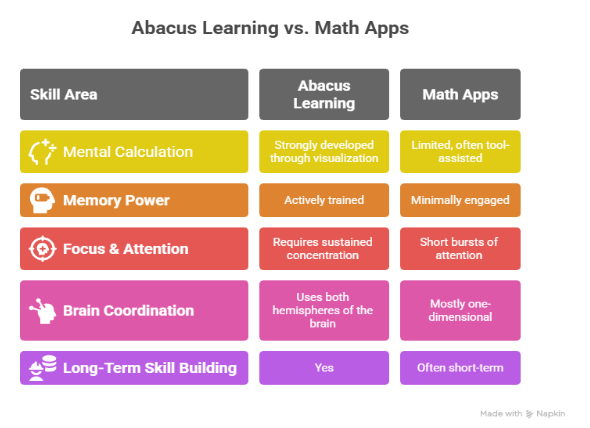
While apps are helpful for practice, the abacus trains the brain itself—not just the fingers on a screen.
Screen Time vs Skill Time
Screen time has now become an unavoidable part of childhood, and for many parents, managing it is a constant concern. While math apps are often labelled as “educational,” they still contribute to the overall hours a child spends in front of a screen. Prolonged screen exposure can lead to reduced attention spans, eye strain, dependency on instant gratification, and a tendency toward passive learning.
Math apps are designed for quick interaction: tap, swipe, move on. Learning becomes fast-paced and reward-driven, with children often more motivated by points or animations than by understanding the concept itself.
Abacus learning, on the other hand, emphasizes skill time over screen time and has many screen-free learning benefits. It is a hands-on, interactive method that requires children to slow down, concentrate, and actively engage their minds. Whether working with a physical abacus or visualizing one mentally, children are fully involved in the learning process.
This screen-free approach helps cultivate essential life skills such as:
- Discipline: Regular abacus practice builds routine and consistency.
- Patience: Children learn to work through problems methodically rather than seeking instant answers.
- Cognitive engagement: Mental calculations demand attention, memory, and logical thinking.
- Independent thinking: Children rely on their own mental ability instead of digital prompts or hints.
In a world dominated by screens, choosing abacus learning is a conscious step toward meaningful, mindful learning, where children build strong brains, not just clock more screen hours. Download the activity pack.
Yes, that’s right! Abacus Mental Math is the right choice for your children. Read More.
Why UCMAS Makes Mental Math and Abacus Truly Effective
Mental math and abacus learning offer powerful benefits on their own, but when delivered through a structured and research-backed program like UCMAS, their impact multiplies significantly. UCMAS goes beyond teaching children how to calculate; it focuses on developing the whole brain, nurturing skills that support lifelong learning and success.
By combining abacus-based learning with systematic mental visualization techniques, UCMAS helps children strengthen concentration, memory, accuracy, and speed. The program’s step-by-step progression ensures that children build a strong foundation first and then advance confidently toward mental math mastery.
What truly sets UCMAS apart is its emphasis on skill development over rote learning. Children are trained to think independently, visualize solutions, and approach challenges with confidence—abilities that extend far beyond mathematics into academics, creativity, and everyday problem-solving.
In an age of increasing screen dependency, UCMAS provides a balanced, screen-free learning environment that promotes discipline, patience, and meaningful cognitive engagement. The result is not just better math performance, but sharper focus, faster thinking, and improved self-belief.
Choose UCMAS to invest in your child’s mental agility and overall brain development. Book a free info session today!