

Math struggles are far more common than most parents realize. While some children seem to grasp numbers effortlessly, others find themselves falling behind despite their best efforts. Homework becomes stressful, tests trigger anxiety, and confidence slowly begins to erode.
The good news is that struggling with math does not mean a child lacks intelligence or potential. In many cases, students simply need a different approach to learning. This is why parents increasingly search for ‘mental maths classes near me’, hoping to find a program that can help their child overcome academic challenges and rediscover confidence.
One solution gaining attention worldwide is abacus mental math training. Unlike traditional tutoring that focuses solely on school curriculum, mental math classes strengthen the cognitive skills that support mathematical learning, including concentration, memory, visualization, and logical thinking.
Today, leading abacus mental math classes are helping children transform from hesitant learners into confident problem-solvers. Let’s explore why students struggle with math and the seven surprising ways abacus maths programs can help them succeed.
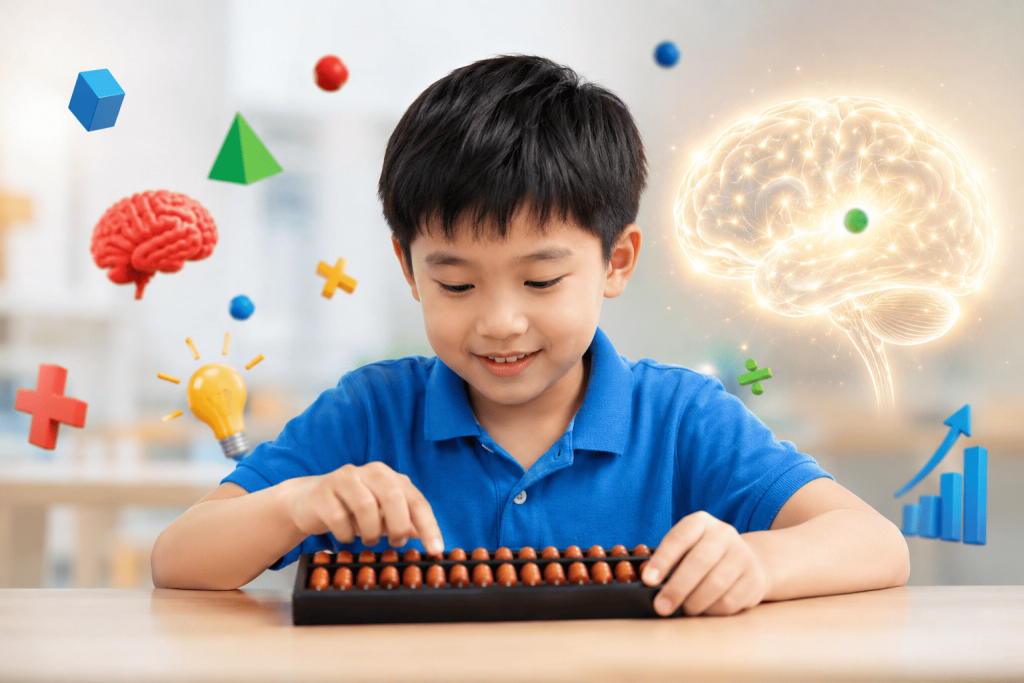
Why Do So Many Students Struggle With Math?
When children struggle with math, parents often assume they need more practice. However, mathematical difficulties are usually more complex than simply getting the wrong answers.
Some common causes include:
Weak Number Sense
Many students lack a natural understanding of how numbers relate to one another. Without strong number sense, even basic calculations can feel overwhelming.
Poor Concentration
Math requires sustained focus and attention. Children who struggle to concentrate often lose track of steps during calculations and problem-solving exercises.
Working Memory Challenges
Students frequently need to hold multiple pieces of information in their minds while solving problems. Weak working memory can make this process difficult.
Fear of Making Mistakes
Many children develop negative feelings toward math after repeated struggles. This anxiety often leads to avoidance and reduced performance.
Overreliance on Calculators
Technology can be useful, but excessive dependence on calculators may prevent children from developing strong mental calculation skills and numerical confidence.
These challenges can quickly snowball, causing students to fall further behind as mathematical concepts become increasingly complex.
Understanding Learning Challenges and Dyscalculia
Not every child who struggles with math simply needs more practice. Some students face genuine learning challenges that affect how they process numerical information.
What Is Dyscalculia?
Dyscalculia is a learning difficulty that affects a person’s ability to understand and work with numbers. It is often referred to as the mathematical equivalent of dyslexia.
Children with dyscalculia may experience difficulties with:
- Recognizing numerical patterns
- Understanding quantities and number relationships
- Memorizing basic math facts
- Estimating values
- Following the calculation sequences
- Understanding time and measurements
- Performing mental calculations
A child with dyscalculia may know that 8 + 5 equals 13 one day but struggle to recall the same fact the next day. These inconsistencies can be frustrating for both students and parents.
Other Learning Challenges That Impact Math
Even children without dyscalculia may struggle due to:
Attention Difficulties
Students who have trouble focusing often miss important instructions or calculation steps.
Working Memory Limitations
Children may understand a concept but struggle to retain information long enough to complete a problem.
Processing Speed Differences
Some students require more time to understand and respond to mathematical information.
Math Anxiety
Anxiety can interfere with concentration, memory retrieval, and overall performance, creating a cycle of repeated frustration.
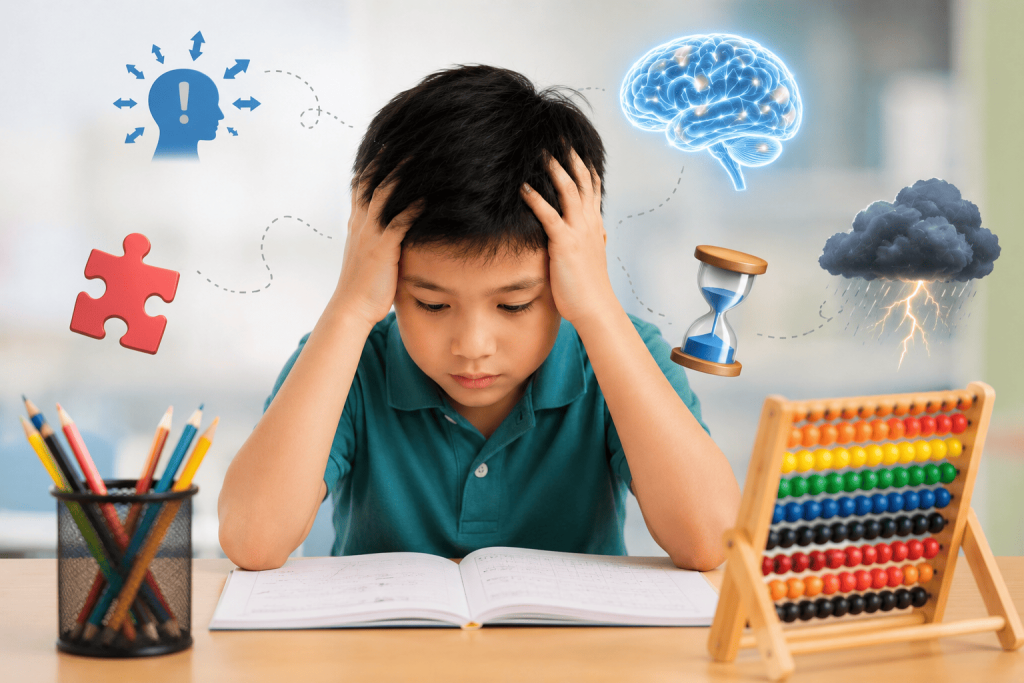
Can Mental Math Help?
While abacus mental math classes are not a treatment for dyscalculia or other learning disorders, they can provide structured exercises that strengthen many underlying cognitive skills.
By engaging visual, auditory, and kinesthetic learning pathways simultaneously, abacus mental math training encourages children to develop stronger concentration, memory, visualization, and numerical awareness.
Many parents report improvements not only in mathematics but also in overall learning confidence.
What Is Mental Math and How Does It Work?
Mental math refers to performing calculations accurately without relying on calculators, paper, or external tools.
Most advanced abacus math programs begin by teaching students to use a physical abacus. As students progress, they learn to visualize the abacus in their minds and manipulate beads mentally.
This technique is known as abacus mental math.
Instead of memorizing formulas, students create mental images and perform calculations through visualization. This process activates multiple regions of the brain simultaneously and helps strengthen neural connections associated with learning.
Many students also supplement their training with mental math worksheets for kids and abacus mental math worksheets, which reinforce classroom learning through guided practice.
The result is faster calculation ability, improved concentration, and stronger cognitive development.
7 Shocking Ways Mental Math Classes Transform Struggling Students
1. They Turn Math Anxiety Into Math Confidence
One of the most dramatic benefits of mental math classes is the confidence they build.
Many struggling students begin to believe they are simply “bad at math.” Each mistake reinforces this belief.
Through structured learning and consistent progress, students experience small victories that gradually rebuild confidence.
As children begin solving problems independently, their fear of mathematics often starts to disappear.
The TransformationThe child who once avoided math homework begins participating actively in class and approaching challenges with confidence. |
2. They Improve Concentration and Attention Span
Successful mental calculations require intense focus.
During abacus maths training, students must visualize numbers, manipulate mental images, and maintain concentration throughout the calculation process.
These exercises effectively train the brain to focus for longer periods. In a world filled with digital distractions, this skill can be incredibly valuable.
The TransformationStudents often demonstrate improved attention not only during math lessons but across all academic subjects. |
3. They Strengthen Working Memory
Working memory plays a critical role in learning.
When children use abacus mental math, they constantly store and manipulate information in their minds. This repeated exercise strengthens their ability to retain and process information.
As working memory improves, students become better equipped to:
- Follow instructions
- Solve multi-step problems
- Retain classroom information
- Complete tasks independently
The TransformationLearning becomes easier because students can manage information more effectively. |
4. They Build Stronger Number Sense
Many students memorize math facts without truly understanding numbers. Abacus math training develops a deeper understanding of numerical relationships.
Students begin recognizing patterns, estimating values, and understanding how numbers interact. This stronger number sense creates a foundation for future mathematical success.
The TransformationInstead of memorizing answers, students understand why answers make sense. |
5. They Develop Powerful Visualization Skills
Visualization is one of the most unique aspects of abacus mental math classes.
As students progress, they learn to see an imaginary abacus in their minds and perform calculations using mental images. This process strengthens visual-spatial intelligence and supports learning in numerous areas, including:
- Mathematics
- Science
- Engineering
- Coding
- Problem-solving
The TransformationStudents become more effective at processing complex information and thinking creatively. |
6. They Enhance Logical Thinking and Problem-Solving
Math success requires more than arithmetic skills. Students need to analyze situations, identify patterns, and choose effective strategies.
Mental math classes train children to think systematically and solve problems efficiently. This logical thinking extends beyond academics and becomes a valuable life skill.
The TransformationStudents become independent thinkers who are comfortable tackling unfamiliar challenges. |
7. They Improve Overall Academic Performance
Parents often enroll their children in an abacus math school, hoping to improve math grades.
What surprises many families is that improvements frequently extend far beyond mathematics. The cognitive skills strengthened through abacus mental math training support learning across multiple subjects.
Teachers often observe improvements in:
- Reading comprehension
- Listening skills
- Classroom participation
- Test-taking ability
- Academic confidence
The TransformationStudents become stronger learners overall, not just stronger math students. |
Supporting Learning at Home
Parents can maximize the benefits of mental math classes by creating opportunities for practice at home.
Useful tools include:
- Daily mental calculation challenges
- Educational number games
- Real-life math activities
- Mental math worksheets for kids
- Abacus mental math worksheets
Consistent practice helps reinforce classroom learning while keeping mathematical thinking enjoyable and engaging.
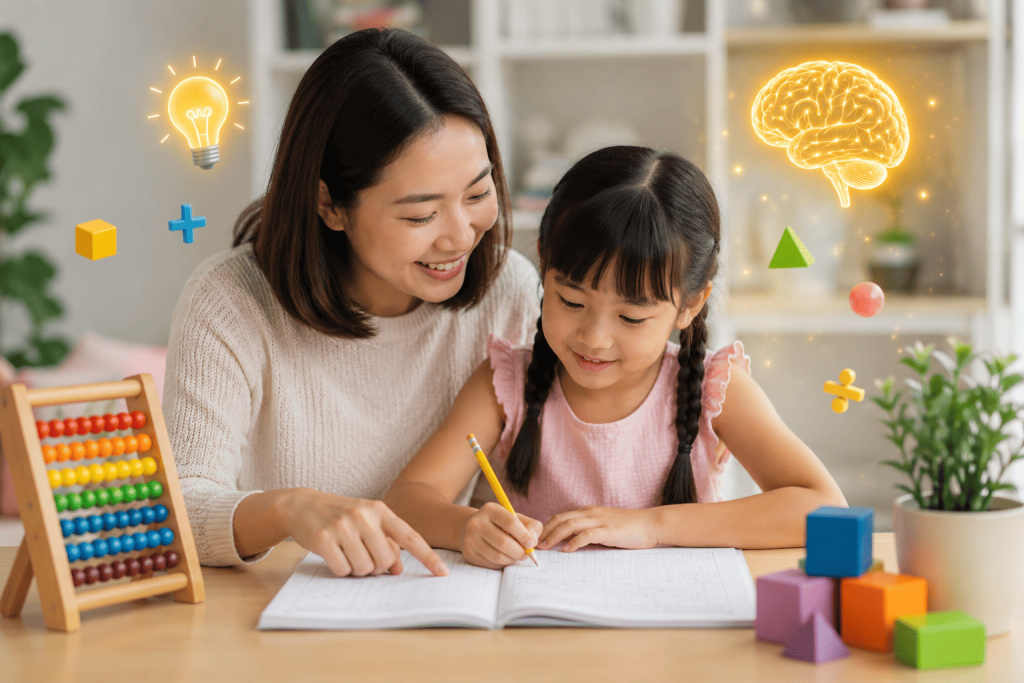
Choosing the Right Mental Math Program
If you’re searching for mental maths classes near me, consider the following factors:
- Structured curriculum
- Certified instructors
- Age-appropriate teaching methods
- Regular assessments
- Cognitive development focus
- Proven learning outcomes
A quality abacus math school should focus not only on calculation speed but also on concentration, memory, confidence, and overall brain development.
Every Math Champion Starts Somewhere
Every child deserves the opportunity to feel confident and capable in mathematics. While math struggles can stem from challenges with concentration, memory, confidence, or number sense, they do not define a child’s potential. With the right guidance and learning approach, students can overcome these obstacles and develop the skills needed to thrive both academically and personally.
This is where programs like UCMAS have made a lasting impact. For decades, the UCMAS abacus mental math program has helped countless children around the world transform their relationship with mathematics. By combining proven abacus mental math techniques with cognitive development training, UCMAS goes beyond improving calculation skills. The program helps children strengthen concentration, memory, visualization, problem-solving, and self-confidence, skills that support success in school and everyday life.
Many students who once struggled with math have gone on to become confident learners, stronger problem-solvers, and enthusiastic participants in the classroom through consistent mental math training. The transformation often extends far beyond better grades, helping children unlock their full learning potential.
If your child is finding math challenging or could benefit from stronger focus, memory, and confidence, now is the perfect time to explore the benefits of UCMAS.
Enroll your child in the nearest UCMAS centre today and discover how the right mental math program can help your child take the first step from struggling student to math champion.
FAQs
Yes. Mental math classes help strengthen important cognitive skills such as concentration, memory, visualization, and logical thinking. These skills support learning across multiple subjects, often leading to improved classroom participation, test performance, and overall academic confidence.
Regular math tutoring typically focuses on helping students understand the school curriculum and complete assignments. Abacus math training, on the other hand, develops the brain’s ability to perform calculations mentally while improving concentration, memory, visualization, and problem-solving skills. It focuses on building foundational cognitive abilities that support long-term learning.
Yes. Mental math exercises require children to concentrate, visualize numbers, and retain information while solving calculations. Regular practice helps strengthen working memory and attention span, which can benefit both academic performance and everyday learning.
Every child progresses at their own pace, but many parents and teachers notice improvements in confidence, concentration, and calculation skills within a few months of consistent practice. Long-term participation often leads to stronger cognitive development and greater academic benefits.
Absolutely. Mental math classes are often especially beneficial for students who lack confidence in mathematics. By introducing calculations through structured and progressive learning methods, children can build stronger number sense, improve focus, and develop a more positive attitude toward math.
Abacus learning helps children develop a wide range of skills, including mental calculation, concentration, memory, visualization, logical reasoning, problem-solving, listening skills, and self-confidence. These abilities support success both inside and outside the classroom.
Mental math worksheets can be an effective learning tool when used alongside structured instruction. They provide additional practice, reinforce classroom concepts, and help children strengthen calculation speed, accuracy, and numerical understanding through regular repetition.
Abacus training engages multiple areas of the brain simultaneously by combining visual, auditory, and kinesthetic learning. As children learn to visualize and manipulate an imaginary abacus, they strengthen neural connections related to memory, concentration, creativity, and analytical thinking, supporting overall cognitive development.