


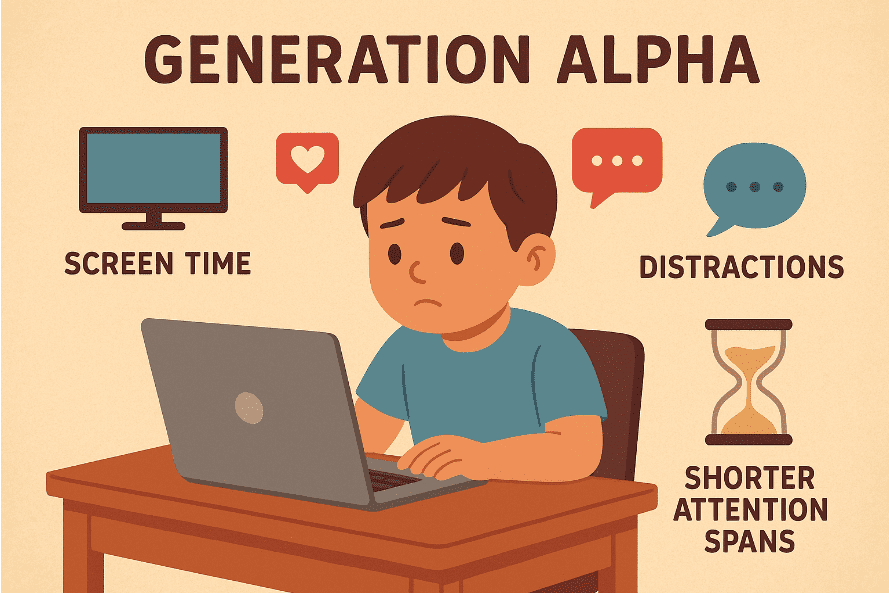
Children born into Generation Alpha (roughly 2010–2024) grow up with more screenscreen time, more distractions, and earlier academic pressure than previous generations. This results in shorter attention spans, test anxiety, and less confidence in tackling new challenges.
Traditional tutoring often fixes a single academic problem (a low grade or missed concept), rather than teaching the cognitive habits that help a child thrive, sustained focus for learning, confidence to try, and self-discipline that supports schoolwork and family life.
Future-Ready Kids Need More Than Just Tutoring
As per an article by Economic Times, over 22% work tasks are expected to be automated by 2030, and the fastest-growing careers will require skills such as problem-solving, adaptability, creativity, and emotional intelligence. So, our children will step into a world where grades alone won’t guarantee success. In summary, children who can think flexibly, focus deeply, and learn new skills quickly will have the greatest advantage.
To give kids an advantage in such a challenging scenario, parents need to think beyond “fixing a grade” and start preparing their children for the mental challenges of the future. This isn’t about pushing them harder in academics; it’s about helping them develop the focus, confidence, and resilience to thrive no matter what comes their way.
How to Prepare Kids for the Future?
To prepare children for the future, parents need to look at education through a wider lens. It’s not just about what they learn, but how they learn and how they approach challenges.
A truly future-ready child needs:
- Sustained focus in an age of distraction
- Confidence to attempt the unfamiliar
- Working memory to juggle ideas and solve problems
- Self-discipline to stick with a task
- Social confidence to work well with others
These aren’t built by memorizing formulas or drilling test papers alone. They come from training the mind in a way that engages multiple senses, strengthens both sides of the brain, and encourages problem-solving in a low-pressure environment.
Where UCMAS Fits In
UCMAS is the one-shot solution that takes these principles and applies them through abacus-based mental math. But it’s not “just math.” By using a multi-sensory learning method, UCMAS trains both sides of the brain, enhancing working memory, concentration, and visualization skills.
In class, children work with their hands, picture problems in their minds, and engage in group activities that build listening skills and social confidence. Over time, parents notice:
- Better focus during homework and classes
- Greater confidence tackling unfamiliar problems
- Faster, more accurate mental calculations
- Improved self-discipline and resilience under pressure
Difference Between UCMAS and Regular Tutoring
One-on-one tutoring focuses solely on curriculum, while UCMAS uses an abacus-based system to create a multi-sensory learning routine. It equips students with –
Aspects | UCMAS Approach | Regular Tutoring |
Hands-on Learning | Uses tools like the Abacus Maths and tactical learning to engage multiple senses. | Focuses mainly on rote learning, worksheets and repetition. |
Mental Visualisation | An engaging learning style where children learn using images, colours and graphics. | Relies on written steps and memorization. |
Social Confidence | Group activities and competitions build communication, teamwork, and public performance skills. | They often prefer quiet study sessions and the social interactions and activities are to a minimum. |
Breaking the Introvert Barrier | Focuses on encouraging children to speak up, share solutions, and gain confidence in group settings. | Usually limited to academic Q&A, offering fewer opportunities to build social ease. |
UCMAS also trains both sides of the brain, leading to faster mental calculations and improved concentration.
A scientific study conducted to explore the impact of Abacus-based mental calculation revealed that it enhances cognitive functions such as working memory and numerical processing. A controlled trial also demonstrated that, just 20 days after Abacus-based mental calculation training, children showed significant improvements in both verbal and visuospatial (picture thinking, visual imagination) working memory.
How UCMAS Boosts Confidence in Children?
UCMAS goes far beyond teaching math; it’s a confidence-building powerhouse for children. Through the tactile and visual experience of abacus mental math, UCMAS consistently celebrates small wins, whether it’s mastering a tricky calculation or visualizing problems in their minds, which fuels a growing sense of accomplishment and self-esteem.
Paired with regular group challenges, competitions, and opportunities to present answers in front of peers, even the most introverted learners gradually develop composure, clarity, and the courage to participate confidently in classroom settings. In essence, every mental math drill is an opportunity for your child to say, “I can do this,” laying the groundwork for bold actions in school and beyond.
Benefits Noticed by Parents
Ask any parent what they truly want for their child, and the answer usually goes beyond good math scores. They want focus, confidence, and resilience. That’s exactly what UCMAS’s Abacus Math delivers, along with these powerful benefits:
- Abacus math improves focus and strengthens working memory and attention.
- Their kids gain the ability to perform mental calculations.
- Early mastery of numbers builds a stronger math foundation and makes math less intimidating.
- Small wins in class and competition result in higher confidence and build self-esteem.
- With consistent class routines, their kids gain better listening skills and self-discipline.
- Grouped and structured activities give them low-pressure social wins.
As per the report from a UCMAS parent,
Parent Checklist
Every child learns best when they feel supported and encouraged. With UCMAS, progress comes through steady steps and playful practice. Here’s how you can guide your child’s journey while keeping it stress-free and rewarding:
- Frame it as fun and skill-building, not extra homework.
- Consistency is the key.
- Confidence among kids grows from small milestones. So, celebrate effort, not only scores.
- Reinforce gains by sharing progress with teachers.
- Treat UCMAS as an evening routine. This helps in creating a calmer homework period later.
Key Benefits of UCMAS
Parents can expect UCMAS to deliver a range of benefits well beyond grades and simple “math tutoring.”
These include –
- Enhanced Focus & Memory: Concentration and memory of bead patterns are required in abacus practice. Research shows this enhances brain power in young learners.
- Speedy Mental Calculations: Quick and accurate mental calculation is a common skill kids gain from the abacus. With the abacus out in their heads, they internalize many math concepts (like place value) that will make future math skills that much easier.
- Strong Math Foundation: Getting addition, subtraction, multiplication, and more right from the start gives a strong base for higher topics.
- Greater Confidence: Children gain higher confidence in mathematics and other aspects of life when they continuously attempt to solve problems or get a place in competitions. The confidence gained in one aspect trickles down to other aspects of life. This gives them an upper hand in trying their luck in making decisions and solving problems.
- Improved Listening & Self-Discipline: UCMAS lessons go with planned talks where kids need to pay close attention and follow rules. Pros say that steady habits like this make children learn self-control and take on change in a good way.
Time Commitment: The UCMAS program generally runs twice a week with 60 minutes per session while reinforcing learning.
UCMAS: Transforming Math into a Lifelong Skill
For parents searching for math tutors for their kid, UCMAS offers a compelling answer. In practice, UCMAS helps children develop vital cognitive skills, master arithmetic, and build self-confidence and discipline. By integrating UCMAS into your child’s routine, you provide them with a structured yet enjoyable way to learn.
For your 5–13 year-old, it can be the difference between rote study and true engagement. It offers the kind of hands-on learning today’s kids need to thrive.
Book a session today and watch them grow stronger academically, gaining confidence.
FAQs
-
1. Is UCMAS just math tutoring?
No. UCMAS uses abacus-based mental math to build attention, memory, and confidence — skills that help across subjects.
-
2. What ages benefit most?
The program is ideal for children ages 5–13, when brain plasticity makes practice especially effective.
-
3. Will it overload my busy child?
UCMAS classes are designed as after-school programs that complement schoolwork. They provide structure and focus rather than extra chaos
-
4. What kind of progress can we expect?
Based on internal surveys, over 85% of parents report noticeable improvements in focus and working memory within 3 months.