

For children between Grades 1 and 5, mathematics plays a crucial role in shaping not only academic performance but also cognitive development. This is the phase where children move from counting objects to understanding patterns, relationships, and problem-solving strategies. Building a strong math foundation in Grades 1–5 ensures that children don’t just learn maths, but enjoy it.
So how can parents and educators support this journey effectively? Let’s explore grade-wise math skills, proven learning strategies, and how mental math programmes help strengthen maths foundations in kids.
Why Grades 1–5 Are Critical for Math Development
Did you know that most math anxiety begins when children move ahead without fully understanding basic concepts? When numbers feel confusing early on, math can quickly become stressful. This is why Grades 1–5 play a crucial role in a child’s math journey.
During these formative years, children are not just learning numbers; they are learning how to think.
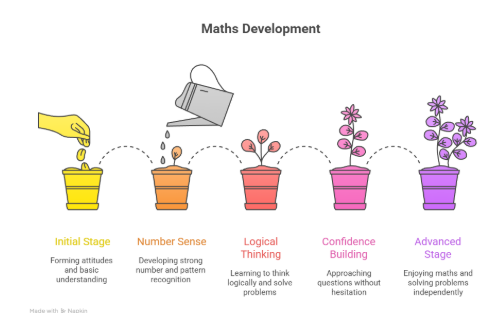
When maths is taught clearly and positively during these years, it creates a strong base for all future learning. A solid maths foundation in Grades 1–5 helps children:
✔ Feel more confident in the classroom
✔ Understand new concepts faster in higher grades
✔ Improve concentration, memory, and focus
✔ Develop strong analytical and reasoning abilities
In short, these early years offer the perfect opportunity to build strong maths foundations for kids, before learning gaps and fear set in. When the foundation is right, everything that follows becomes easier and more enjoyable.
What Makes a Strong Math Foundation?
Before we look at grade-wise math learning, it’s important to understand how children learn maths best. A strong math foundation is not built overnight, and it’s not built by memorising formulas alone. It is created through understanding, practice, and positive experiences with numbers.
Let’s explore the key elements that truly strengthen maths foundations for kids.
1. Clear Understanding, Not Just Memorisation
Memorising answers may help children score marks temporarily, but it does not help them learn. When children understand why a solution works, maths starts to make sense.
When children grasp the logic behind addition, subtraction, multiplication, or division, they stop relying on guesswork and start thinking independently. This deeper understanding is what builds long-term confidence in maths.
2. Regular Practice Without Pressure
Maths improves with practice, but only when it is done the right way.
Short, regular practice sessions are far more effective than long, stressful study hours. When learning is pressure-free, children are more willing to try, make mistakes, and learn from them. A calm and encouraging environment helps maths feel achievable rather than overwhelming.
3. Mental Math Skills
Mental math is a powerful tool in building a strong math foundation. When children learn to calculate in their minds, they improve more than just their maths skills.
Children who practise mental math regularly often feel more confident in exams and everyday situations because they trust their own thinking.
4. Learning Through Real Life
Maths becomes easier when children see how it connects to the world around them. When maths is linked to everyday activities such as counting money, measuring ingredients, or calculating time, it feels practical and meaningful.
By bringing maths into daily routines, parents can turn ordinary moments into valuable learning opportunities.
Grade-Wise Math Skills: What Should Children Learn?
Every grade builds on the one before it. When children clearly understand the right concepts at the right time, maths feels logical and manageable. However, when learning gaps appear, even simple problems can become difficult to solve.
Understanding grade-wise math skills helps parents support their child’s learning more effectively and ensure they are developing strong maths foundations as kids.
Grade 1: Building Comfort with Numbers
Grade 1 is all about helping children feel comfortable with numbers and basic calculations. At this stage, children learn best through visual and hands-on activities. Using objects, pictures, and simple games helps them understand numbers rather than just memorising them. Maths should feel fun and approachable in Grade 1.
Key skills children should learn |
|
Grade 2: Strengthening the Basics
In Grade 2, children begin to build on what they already know and apply it in slightly more complex ways.
Children start moving away from counting on fingers and begin calculating mentally. Encouraging children to explain how they arrived at an answer helps strengthen their understanding and builds their confidence.
Key skills children should learn |
|
Grade 3: Developing Mathematical Thinking
Grade 3 is an important transition year. Maths becomes more structured and requires children to think more deeply.
Many children face challenges here because maths becomes less visual and more abstract. Strong mental math skills and step-by-step problem-solving techniques help children stay confident during this stage.
Download the free practice worksheet for Grade 3
Key skills children should learn |
|
Grade 4: Improving Accuracy and Logical Reasoning
By Grade 4, children are expected to handle larger numbers and more detailed problems.
Speed and accuracy become more important at this stage. Children benefit greatly from learning techniques that help them calculate efficiently while staying focused.
Key skills children should learn |
|
Grade 5: Preparing for Advanced Mathematics
Grade 5 prepares children for the transition to middle school and more advanced maths concepts.
Children are encouraged to solve problems independently and explore different ways to reach the same solution. A strong foundation at this stage makes higher-level maths less intimidating and more manageable.
Key skills children should learn |
|
Common Mistakes That Can Weaken Math Foundations
Why Mental Math Is So Important for Kids
Mental math plays a powerful role in building a strong math foundation for kids. It encourages children to think, calculate, and solve problems using their minds, without relying on calculators or written steps for every question.
Mental math helps children:
- Calculate faster and more efficiently
- Improve memory, concentration, and attention span
- Think clearly and stay calm under pressure
- Build confidence in their problem-solving abilities
When children practise mental math regularly, they become more comfortable working with numbers. They learn to trust their thinking and approach problems with confidence.
Over time, these skills go beyond maths. Children who are strong in mental math often show better performance in other subjects as well, as they develop sharper focus, quicker thinking, and stronger analytical skills.
By strengthening mental math early, parents can help children build a solid foundation that supports learning both inside and outside the classroom.
How UCMAS Helps Build Strong Math Foundations
UCMAS is specially designed to support children during their most important learning years, Grades 1 to 5. The programme goes beyond traditional teaching by helping children understand numbers, think clearly, and build confidence in maths.
UCMAS uses abacus-based learning to give children a strong visual understanding of mathematical concepts. This hands-on approach makes calculations easier to grasp and reduces confusion. As children progress, they gradually move from using the physical abacus to performing calculations mentally, strengthening their mental math skills.
The programme also supports balanced brain development, engaging both the logical and creative sides of the brain. This improves concentration, memory, listening skills, overall learning ability, and benefits that extend beyond maths into other subjects as well.
Most importantly, UCMAS doesn’t just teach children how to calculate, it teaches them how to think, analyse, and solve problems with confidence.
Learn with UCMAS now and give your child a strong maths foundation for the future