

Texas is rapidly emerging as one of the most powerful education and technology ecosystems in the United States. With booming tech hubs like Austin, Dallas, and Houston, and a growing demand for job-ready skills, STEM learning is no longer optional; it is becoming foundational. This shift is creating massive opportunities for investors looking at a STEM education franchise in Texas as a long-term, scalable business model.
The education sector is evolving quickly, and STEM-focused franchises are at the center of this transformation. Backed by strong market growth, government support, and parental demand, STEM education is moving from a niche offering to a mainstream necessity in the U.S. education economy.
Why Texas Is Becoming a Hotspot for STEM Education Franchises
Texas is uniquely positioned for education innovation because it sits at the intersection of three powerful forces: population growth, tech industry expansion, and workforce demand.
Austin alone has been ranked among the top U.S. metros for STEM professionals, thanks to its high concentration of tech jobs and rapid job growth in science and engineering fields. Dallas and Houston also continue to expand their STEM ecosystems, supported by aerospace, energy, healthcare, and software industries.
At the same time, Texas is experiencing strong growth in its school-age population, which directly increases demand for tutoring, enrichment programs, and after-school learning solutions. This combination makes Texas one of the most attractive markets for an education franchise focused on STEM learning.
(Source: Chron)

The Explosive Growth of STEM Education: The Numbers Behind the Trend
The global STEM education market is growing at a remarkable pace. Recent industry research shows:
- The global K–12 STEM education market was valued at over USD 60 billion in 2024 and is projected to surpass USD 131 billion by 2030, growing at a CAGR of around 13.7% (Grand View Research)
- The U.S. STEM education market alone is expected to nearly double from $19 billion in 2024 to over $36 billion by 2030, growing at approximately 11.1% CAGR (Grand View Research)
- STEM jobs in the U.S. have grown faster than non-STEM roles, with salaries averaging nearly $112,800 annually, almost double the national average (RCLCO Real Estate Consulting)
These figures reflect a clear reality: STEM education is no longer just an academic enhancement; it is a pipeline into high-income careers.
For investors, this creates a strong foundation for a scalable education business franchise model in Texas.
Trend #1: Robotics, Coding, and AI Are Driving Franchise Demand
One of the biggest shifts in the best education franchise opportunities is the integration of advanced technologies like robotics, coding, and artificial intelligence into early education.
Modern STEM franchises are no longer limited to math tutoring or science worksheets. Instead, they are offering:
- Robotics labs and competitions
- Coding bootcamps for kids
- AI-based learning platforms
- 3D printing and design thinking modules
A systematic review of STEM education innovations shows that AI tools such as intelligent tutoring systems and adaptive learning platforms are already being widely adopted in classrooms, especially in mathematics education.
This means future-ready STEM franchises will increasingly blend physical learning centers with digital ecosystems, making them more scalable and profitable.
Trend #2: Math Franchises Are Becoming the Entry Point for STEM Learning
Among all STEM segments, the math franchise category remains the strongest entry point for young learners.
Math is the foundation for coding, engineering, robotics, and data science. Parents increasingly enroll children in math enrichment programs before introducing them to broader STEM disciplines.
Franchise models are now focusing on:
- Abacus-based learning
- Mental math
- Problem-solving frameworks
- Competitive exam preparation
This has led to a strong demand in Texas suburban markets where academic performance pressure is high. This makes math-focused franchises a gateway segment within the broader STEM ecosystem.
Trend #3: Hybrid Learning Models Are Becoming the New Standard
The future of STEM education franchises in Texas will not be purely physical or fully online; it will be hybrid.
Franchise operators are increasingly combining:
- Physical learning centers
- Online tutoring platforms
- Mobile learning apps
- AI-powered dashboards for parents
This hybrid approach ensures scalability while reducing operating costs.
Post-pandemic education behavior has permanently shifted toward digital-first learning support, but parents still prefer in-person engagement for STEM experimentation and hands-on learning. This dual demand is shaping the next generation of education franchise opportunities.
Trend #4: Workforce Alignment Is Driving Government and Corporate Funding
Texas has become a major hub for workforce development partnerships. Corporations and institutions are investing heavily in STEM pipelines to secure future talent.
For example, major U.S. workforce projections suggest STEM occupations will continue growing significantly, with demand for skilled professionals rising sharply over the next decade (San Antonio Express-News).
As a result:
- Schools are partnering with franchise providers
- Corporations are funding STEM labs
- Local governments are supporting after-school STEM programs
This ecosystem creates a strong tailwind for franchise investors because demand is no longer purely consumer-driven; it is institutionally supported.
Trend #5: Franchise Scalability Is Increasing with Low-Capex Models
One of the most attractive aspects of a STEM education franchise in Texas is its relatively low capital requirement compared to traditional schools. Modern franchise models often offer:
- Plug-and-play curriculum systems
- Centralized teacher training
- Standardized robotics kits and STEM tools
- Brand-backed marketing systems
This reduces operational complexity and allows rapid expansion across suburban and semi-urban Texas markets.
Additionally, franchisors are increasingly offering micro-franchise formats that allow investors to open smaller learning centers in malls, community spaces, or even school partnerships.
Trend #6: Parental Demand for Future-Ready Skills Is Surging
Parents today are far more aware of the changing job market than a decade ago. The rise of AI, automation, and digital transformation has created urgency around future skills.
Key parental motivations include:
- Preparing children for high-paying STEM careers
- Reducing dependency on rote learning systems
- Improving problem-solving and analytical thinking
- Gaining early exposure to technology tools
This shift is fueling strong demand for STEM-focused education business franchise models that promise measurable outcomes and career readiness.
Texas Advantage: Why Investors Should Pay Attention Now
Texas offers a rare combination of conditions that make it ideal for STEM franchise growth:
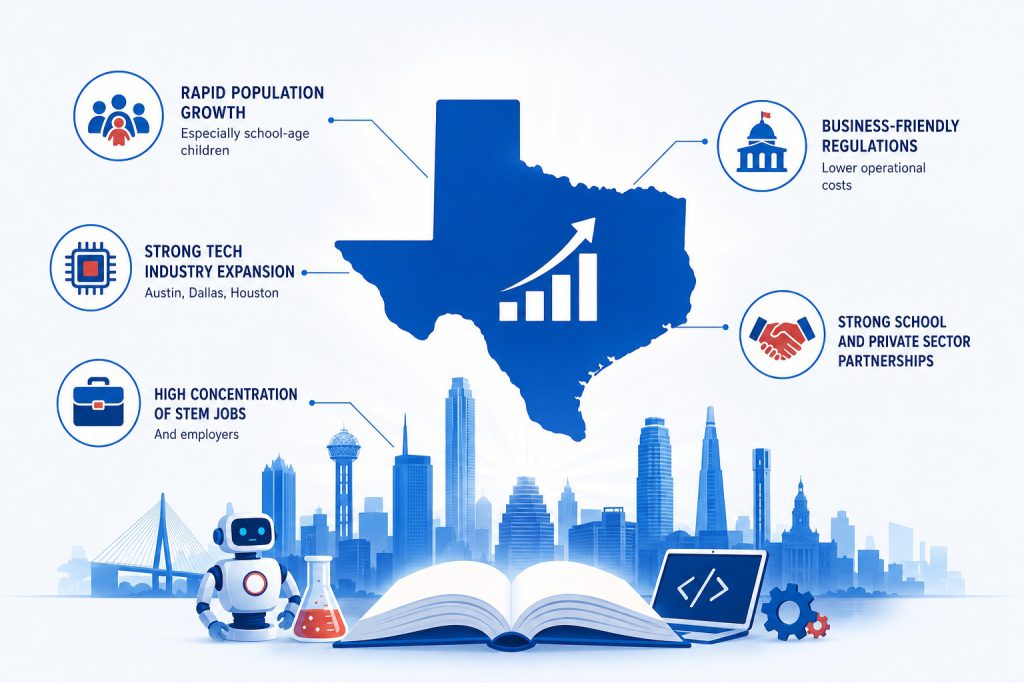
- Rapid population growth (especially school-age children)
- Strong tech industry expansion (Austin, Dallas, Houston)
- High concentration of STEM jobs and employers
- Business-friendly regulations and lower operational costs
- Strong school and private sector partnerships
Austin alone continues to attract major tech employers and ranks among the top STEM job markets in the country (Chron).
This creates a natural pipeline between education providers and future employment opportunities—something few other states can match at this scale.
Investment Outlook: What the Next 5–10 Years Look Like
Looking ahead, the STEM education franchise sector in Texas is expected to evolve in three major directions:
1. Consolidation of Franchise Brands
Smaller education providers will merge or be acquired by larger franchise networks.
2. AI-Driven Personalization
Learning platforms will increasingly use AI to customize student learning paths in real time.
3. Expansion into Rural and Secondary Cities
Cities beyond Austin and Dallas—such as San Antonio, Lubbock, and El Paso—will become new franchise growth zones.
With STEM education projected to more than double in market size over the next decade, early investors in this space stand to benefit significantly from long-term compounding growth.
A Future-Ready Investment with UCMAS
The future of education in Texas is being shaped by a growing demand for STEM skills, critical thinking, and cognitive development. As parents increasingly seek programs that go beyond traditional academics, the most successful STEM education franchises will be those that build strong foundations in learning while preparing children for a technology-driven future.
This is where UCMAS stands out. While many STEM programs focus solely on coding or robotics, UCMAS develops the core cognitive abilities that power success across all STEM disciplines, concentration, problem-solving, visualization, analytical thinking, and mental agility. Through its proven mental math and brain development methodology, UCMAS equips children with skills that support long-term academic achievement and future STEM readiness.
For entrepreneurs exploring a STEM education franchise in Texas, UCMAS offers a compelling opportunity to enter a high-growth market with an established global brand, a proven curriculum, and a scalable business model. As demand for quality enrichment programs continues to rise, investing in a franchise that combines educational impact with strong business potential can position you at the forefront of the next wave of educational innovation.
Ready to be part of Texas’ growing STEM education movement? Explore UCMAS franchise opportunities today!
FAQs
Texas combines strong population growth, a booming technology sector, and increasing demand for STEM skills. This creates a growing market for education franchises that help students develop future-ready competencies while offering investors a scalable business opportunity.
Abacus mental math builds key STEM skills such as logical reasoning, problem-solving, concentration, and analytical thinking. These foundational abilities support success in mathematics, coding, engineering, and other STEM disciplines.
Key trends include AI-powered personalized learning, coding and robotics programs, hybrid learning models, greater focus on cognitive skill development, and rising demand for STEM education in suburban and emerging markets.