
Take a moment to reflect on your own school years.
Do you remember staying up late the night before an exam, memorizing answers word-for-word, only to realize a few weeks later that most of it had faded away? Now, think about learning how to ride a bicycle. There were no textbooks, no written instructions, and no formulas to memorize. Yet, once you learned it, the skill stayed with you for life.
This contrast highlights a powerful truth about how we learn. The difference between quickly forgotten exam answers and a lifelong skill lies in the method of learning, rote memorization versus hands-on experience.
In today’s rapidly evolving world, education can no longer revolve around repetition and recall alone. Children are expected to do far more than remember information. They must understand concepts, apply knowledge in new situations, solve problems independently, and think critically. These abilities cannot be developed through memorization alone.
This is where hands-on learning emerges as a far more effective approach. By actively engaging children in the learning process, especially during early childhood and foundational years, hands-on learning builds deeper understanding, stronger retention, and lasting cognitive skills that rote memorization often fails to deliver.
In this blog, we will explore both rote memorization and hands-on learning and determine which of these methods contributes to effective learning.
What Is Rote Memorization and How Does It Work?
Rote memorization is a traditional learning approach that relies heavily on repetition. In this method, children are encouraged to memorize facts, formulas, definitions, or procedures; often without fully understanding the concepts behind them. The primary focus is on recall, not comprehension.
Common Examples of Rote MemorizationRote learning is widely used in classrooms and at home, especially during exam preparation. Some typical examples include:
|
While these practices may produce quick results, they often stop at memorization rather than true learning.
How Rote Memorization Typically Works
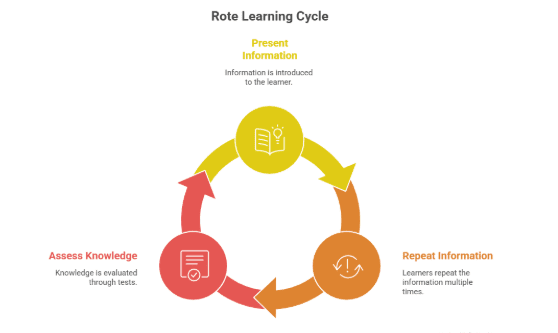
This cycle emphasizes memory over understanding and rewards repetition rather than reasoning.
The Key Drawback of Rote Learning
The biggest drawback of rote memorization is that it leads to surface-level understanding. Information is stored temporarily in the brain without forming strong neural connections. As a result, knowledge fades quickly once exams are over, making long-term retention unlikely.
This raises an important question for parents and educators alike: Can your child explain why an answer is correct, or can they only repeat it?
In today’s world, where understanding, adaptability, and problem-solving are essential, this distinction matters more than ever.
What Is Hands-On Learning and Why Is It More Effective?
Hands-on learning, also known as experiential or active learning, is an educational approach where children learn through direct experience rather than passive instruction. Instead of simply listening, memorizing, or repeating information, children actively participate in the learning process by doing, exploring, and interacting with concepts in a meaningful way.
This approach transforms learning from a one-way transfer of information into an engaging, two-way experience where understanding takes priority over memorization.
How Hands-On Learning Works
In hands-on learning, children actively engage with concepts using multiple methods.
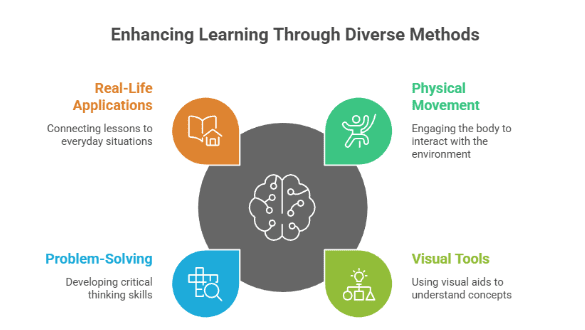
By involving the learner directly, hands-on learning makes abstract ideas concrete and easier to grasp.
Common Examples of Hands-On Learning for Kids
Hands-on learning can be seen across subjects and age groups. Some simple yet powerful examples include:
- Using beads, blocks, or counters to understand numbers and operations
- Conducting experiments to observe scientific principles instead of only reading about them
- Solving puzzles and challenges that require logical thinking rather than memorizing formulas
- Learning and visualizing mathematics through tools like the abacus, which allow children to see and feel numbers in action
Why Is Hands-On Learning So Effective? The Science Behind It
Hands-on learning for kids is highly effective because it aligns with how the brain is naturally designed to learn. Neuroscience shows that children learn best when they actively engage with information rather than passively receiving it. When a child participates in hands-on activities, the brain doesn’t rely on a single learning channel—it activates multiple neural systems at the same time, significantly strengthening the learning process.
Multi-Sensory Brain Engagement
During hands-on learning, information is processed through several interconnected pathways:
- Visual pathways: The child sees concepts represented through objects, patterns, or movement, helping the brain form clear mental images.
- Kinesthetic pathways: Touching, moving, and manipulating objects engages the motor cortex, reinforcing memory through physical action.
- Cognitive pathways: The brain actively analyzes, reasons, and makes decisions, rather than simply recalling stored information.
When these pathways work together, the brain forms stronger and more interconnected neural networks. This makes learning more stable, meaningful, and easier to retrieve later.
A Simple Example: Learning SubtractionConsider teaching a child subtraction. Traditional rote method: Hands-on learning method: |
Cognitive Benefits of Hands-On Learning
Hands-on learning for kids engages the brain at a deeper level by combining movement, sensory input, and thinking. This rich neural engagement leads to lasting cognitive benefits that influence how children learn, think, and respond to challenges: not just in the classroom, but in everyday life.
Stronger Conceptual Understanding
Hands-on learning helps children move beyond memorizing procedures to truly understanding concepts. When children interact with learning materials, by touching, moving, visualizing, or experimenting, they see how and why something works.
For example, instead of memorizing a math formula, a child using physical objects or visual tools can observe patterns and relationships firsthand.
This builds logical thinking and ensures that learning is rooted in comprehension rather than repetition. As a result, children can explain concepts in their own words and apply them confidently across subjects.
Improved Memory Retention
Memory strengthens when learning involves multiple senses. Experiential learning benefits children by activating their visual, motor, and cognitive pathways simultaneously, making information easier to store and retrieve.
Children are far more likely to remember what they:
- See
- Touch
- Do
Compared to what they only hear or repeat, experiential learning creates stronger memory traces in the brain. This reduces the common problem of “learning today, forgetting tomorrow” and supports long-term retention, especially in foundational subjects like math and science.
Enhanced Problem-Solving Skills
Hands-on learning encourages children to think independently and flexibly. Rather than following fixed steps, children are challenged to explore solutions, test ideas, and learn from mistakes.
This process strengthens:
- Analytical thinking
- Logical reasoning
- Decision-making skills
When faced with unfamiliar problems, hands-on learners are more likely to adapt their knowledge creatively rather than feel stuck. These problem-solving abilities extend beyond academics into real-life situations, preparing children for complex challenges in the future.
Better Focus and Attention
Active participation naturally improves focus. Hands-on activities require children to be present, attentive, and engaged, reducing distractions and mental fatigue.
Unlike passive learning methods, where attention can drift easily, hands-on learning keeps the brain alert by involving:
- Movement
- Visual tracking
- Continuous interaction
Over time, this builds longer attention spans and improves the ability to concentrate, an essential skill in today’s fast-paced, screen-heavy environment.
Greater Confidence in Learning
Understanding builds confidence. When children learn through hands-on methods, they feel a sense of control over their learning because they know what they are doing and why it works.
This confidence:
- Reduces fear of mistakes
- Encourages curiosity and questioning
- Builds resilience when facing challenges
Instead of seeing errors as failures, children view them as part of the learning process. This positive mindset fosters self-belief, independence, and a healthy attitude toward learning.
The cognitive benefits of hands-on learning go far beyond academic performance. By strengthening understanding, memory, focus, and confidence, hands-on learning helps children develop the mental tools they need to become independent thinkers and lifelong learners.
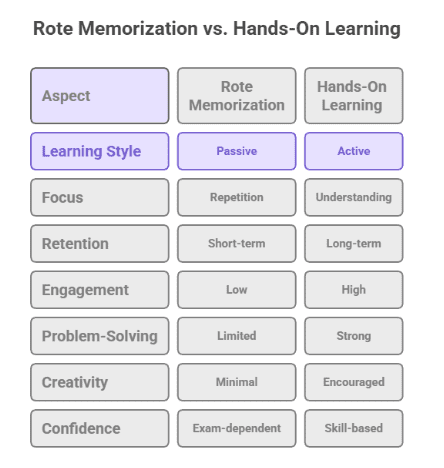
Comparison Between Rote Memorization and Hands-On Learning
UCMAS and Its Principles of Hands-On Learning
UCMAS is a powerful example of hands-on learning in action. Instead of relying on rote memorization, UCMAS helps children experience numbers through a structured, interactive approach that builds understanding from the ground up.
The program begins with physical abacus manipulation, where children move beads to perform calculations. This hands-on process engages sight and touch, making relationships among quantity, value, and number clear and tangible. As children progress, they gradually transition from using a physical abacus to visualizing it mentally, allowing them to perform calculations through imagery rather than written steps.
This journey from concrete to abstract thinking strengthens key cognitive skills such as memory, concentration, speed, and accuracy. More importantly, UCMAS goes beyond math. It helps children develop focus, analytical thinking, listening skills, and confidence, especially when working under time pressure.
Mental math and abacus learning are not separate methods; they are branches of the same tree. The strong hands-on foundation provided by the abacus enables mental math skills to grow accurately and confidently.
As parents who are continually on the search to improve the quality of education for your child, give them the advantage of learning by doing. Explore how UCMAS can build strong thinking skills, confidence, and a lifelong love for learning, starting today. Enroll your child now to experience the UCMAS advantage!
FAQs
Not at all. Rote memorization has its place, for example, learning spellings, basic facts, or vocabulary. However, when learning relies only on memorization without understanding, children may struggle to apply knowledge. A balanced approach works best, with hands-on learning forming the foundation and memorization supporting it.
Hands-on learning improves conceptual clarity, which leads to better academic performance. When children understand why something works, they can:
- Solve unfamiliar problems
- Apply concepts across subjects
- Retain information for longer periods
This results in stronger exam performance and reduced learning anxiety.
Yes—especially at a young age. Early childhood is when the brain develops most rapidly. Hands-on learning supports this development by engaging multiple senses. Tools like the abacus in UCMAS make abstract concepts tangible, helping young learners build a strong cognitive foundation early on.
Hands-on learning may look like play, but it is structured and purposeful. Every activity has a learning objective, whether it’s improving concentration, understanding numbers, or developing problem-solving skills. Children learn best when they are engaged and enjoying the process.
Absolutely. Hands-on learning develops essential life skills such as focus and attention, logical reasoning, confidence, decision-making, and stress management.
Programs like UCMAS are designed to support whole-brain development, not just academic excellence.
UCMAS begins with physical abacus manipulation, allowing children to see and feel numbers. As skills progress, children visualize the abacus in their minds, strengthening memory and concentration. Unlike traditional math classes that rely on repetition, UCMAS focuses on understanding, visualization, and application.
Yes. Many children struggle with math because they memorize steps without understanding concepts. Hands-on learning breaks math down into visual and logical components, making it less intimidating and more intuitive. This often transforms fear into confidence.
Hands-on learning is not a trend; it’s backed by neuroscience and educational research. As the world shifts toward skills like critical thinking and adaptability, experiential learning approaches like UCMAS are becoming increasingly relevant and future-ready.