

Every parent has seen it.
One child hears a question and answers immediately. Another needs a few extra moments to process the same information.
Naturally, many parents wonder: Can thinking speed actually be improved, or is it something children are simply born with?
The good news is that modern neuroscience suggests the brain is remarkably adaptable. Through the right kind of training, children can strengthen cognitive skills such as memory, focus, problem-solving, and processing speed.
This is one of the reasons programs like UCMAS have gained worldwide recognition. Rather than teaching children to memorize answers, UCMAS focuses on helping them develop the mental abilities that support faster and more effective thinking.
Let’s separate myths from facts and uncover the truth.
What Does "Thinking Faster" Actually Mean?
When parents hear the phrase “thinking faster,” they often imagine children solving math problems instantly.
In reality, faster thinking involves several brain functions working together:
- Processing information quickly
- Maintaining concentration
- Recalling information efficiently
- Making decisions confidently
- Solving problems accurately
- Switching between tasks effectively
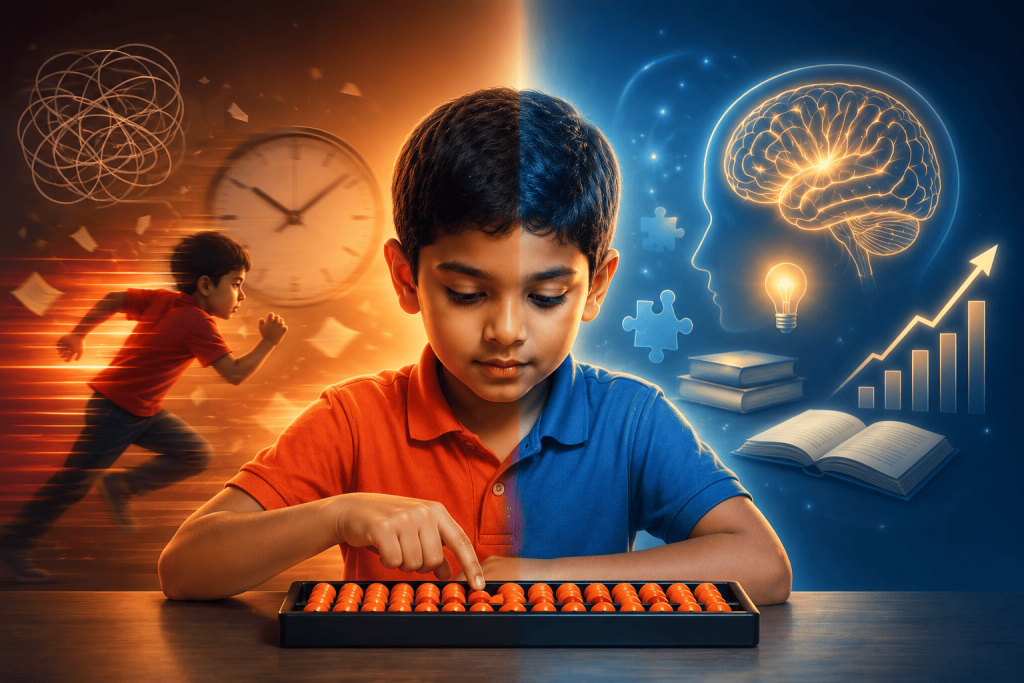
Children who think faster aren’t necessarily rushing. They are simply processing information more efficiently.
This efficiency can influence academic performance, confidence, and everyday decision-making.
Is Faster Thinking Something Children Are Born With?
Partially—but not entirely.
While genetics can influence certain cognitive abilities, researchers have consistently found that the brain changes based on experiences and practice.
This concept is known as neuroplasticity.
Just as muscles become stronger through exercise, neural pathways become stronger through repeated mental challenges.
This means children can improve important cognitive skills through structured learning activities and brain-training exercises.
How Abacus Training Develops Faster Thinking
One of the most effective methods for strengthening mental processing skills is abacus training.
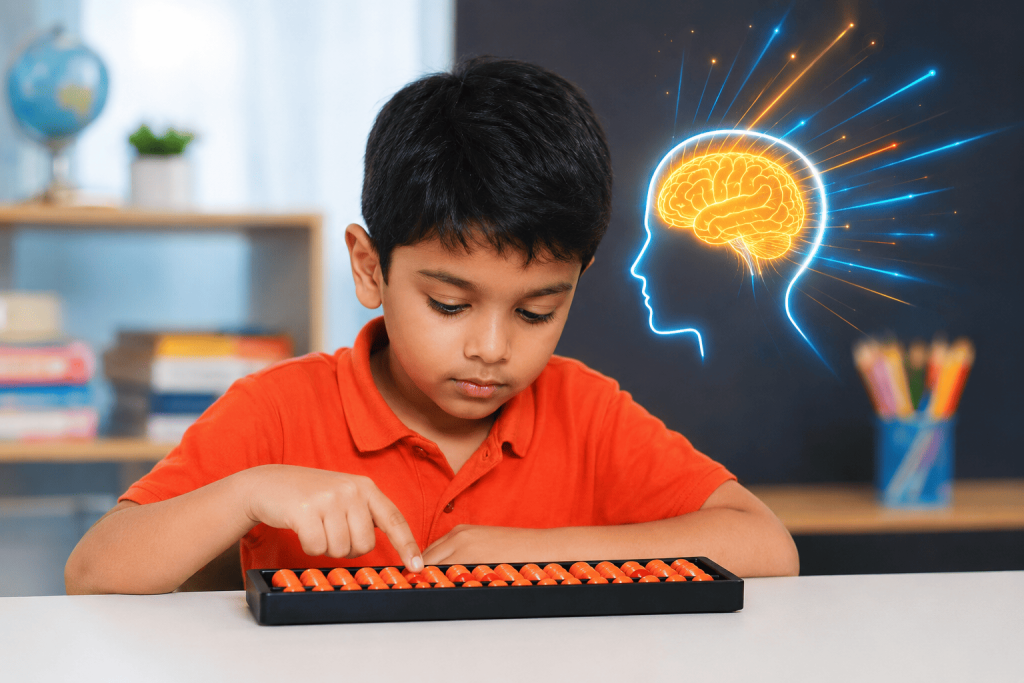
Unlike traditional mathematics instruction, abacus math requires children to visualize and manipulate beads mentally while solving calculations.
Over time, students stop relying on a physical abacus and begin performing calculations using a mental image of the tool.
This process activates multiple regions of the brain simultaneously.
Children must:
- Visualize numbers
- Remember bead positions
- Perform calculations mentally
- Maintain focus under time constraints
- Recall information quickly
This unique combination helps strengthen several cognitive functions at once.
You can learn more about how this process works in our article on why abacus teaches children how to think.
What Happens Inside the Brain During Abacus Mental Math?
When children practice abacus mental math, they are doing much more than solving equations.
Research suggests that abacus learners often engage both hemispheres of the brain.
The left hemisphere typically handles logical reasoning and calculations.
The right hemisphere contributes visualization, imagination, and spatial awareness.
Because children are visualizing an imaginary abacus while performing calculations, both sides of the brain become actively involved.
This balanced engagement may contribute to improvements in:
- Memory
- Concentration
- Observation skills
- Listening abilities
- Visualization
- Processing speed
This is why many parents notice improvements that extend far beyond mathematics.
Faster Thinking vs Better Thinking
An important distinction needs to be made.
The goal is not simply to make children answer quickly.
The goal is to help them think clearly, accurately, and confidently.
Children who develop strong mental processing abilities often:
- Understand instructions faster
- Complete schoolwork more efficiently
- Retain information longer
- Feel less overwhelmed during exams
- Make fewer careless mistakes
Speed without accuracy is not useful.
UCMAS focuses on developing both.
Signs Your Child May Benefit From Brain Skill Training
Every child develops at a different pace.
However, some signs may indicate that additional cognitive training could be beneficial:
- Difficulty concentrating for long periods
- Slow response during classroom activities
- Trouble remembering instructions
- Lack of confidence during problem-solving
- Easily distracted during homework
- Hesitation when making decisions
If these challenges sound familiar, you may find our guide on signs your child needs brain skill training helpful.
Why Mental Math Training Is Different From Traditional Tutoring
Traditional tutoring often focuses on improving subject knowledge.
Brain development programs focus on strengthening the skills that support learning itself.
For example, mental math classes don’t simply teach children to solve calculations.
They train children to:
- Focus for longer periods
- Process information faster
- Visualize complex concepts
- Improve memory recall
- Build confidence under pressure
These skills can positively influence performance across multiple academic subjects.
This is why many parents searching for mental maths classes near me are increasingly considering cognitive development programs rather than conventional tutoring alone.
Can Technology Replace Abacus Learning?
Digital tools offer convenience, but they cannot fully replicate the mental visualization process central to abacus maths training.
Many educational apps provide instant answers.
Abacus learning requires children to create answers mentally.
That difference matters.
The mental effort involved strengthens neural pathways and encourages active thinking rather than passive consumption.
For families seeking flexibility, many programs now offer abacus learning online, making it possible to access structured training from home while maintaining the benefits of the methodology.
Why Parents Around the World Choose UCMAS
UCMAS has helped millions of children across more than 80 countries develop stronger cognitive abilities through a proven abacus math program.
Parents often report improvements in:
- Focus
- Memory
- Confidence
- Observation
- Academic performance
- Problem-solving abilities
What makes UCMAS unique is that it combines structured abacus mental math classes with long-term cognitive development goals.
The emphasis is not merely on calculations but on helping children become more effective learners.
The Real Truth About Faster Thinking
So, can children be trained to think faster?
Yes—but not through shortcuts, gimmicks, or memorization hacks.
Children develop faster thinking by strengthening the underlying skills that support learning: concentration, memory, visualization, and problem-solving.
Programs built around abacus training provide a structured way to develop these abilities over time.
The result isn’t simply faster calculations.
It’s a child who approaches learning with greater confidence, efficiency, and mental agility.
Give Your Child the Tools to Think Smarter
Every child has incredible potential.
The question is whether they are given the right opportunities to develop it.
At UCMAS, children learn far more than mathematics. They develop concentration, memory, confidence, and lifelong thinking skills that support success in school and beyond.
Ready to discover what your child is capable of? Book a Free Assessment Today.
FAQs
Yes. Abacus training encourages children to process information, visualize numbers, and perform calculations mentally. Over time, this can improve concentration, memory recall, and overall mental processing efficiency.
Mental math training may strengthen cognitive abilities associated with intelligence, such as working memory, attention, and problem-solving. However, IQ is influenced by many factors and should not be viewed as the only measure of intelligence.
Children first learn calculations using a physical abacus. As they progress, they visualize the abacus mentally and perform calculations without physical tools, strengthening visualization and mental processing skills.
Most children can begin abacus programs between the ages of 4 and 13. Starting early often helps children take advantage of key developmental stages related to memory and learning.
Absolutely. Many children who learn at a slower pace benefit from structured cognitive training. Consistent practice can improve focus, confidence, memory, and information processing abilities.
Multiple studies have explored the cognitive benefits associated with abacus-based mental math training. Research has linked it to improvements in attention, visualization, working memory, and mathematical performance.
Every child is different, but many parents notice positive changes within a few months of consistent training. Improvements often appear first in focus, confidence, and concentration before academic gains become visible.
Parents choose UCMAS because it focuses on overall cognitive development rather than just mathematics. The program helps children strengthen concentration, memory, visualization, and learning confidence through a structured and proven approach.