

Artificial Intelligence is transforming how children learn, work, and solve problems. As schools across America continue emphasizing science, technology, engineering, and mathematics, parents are asking an important question: How can I prepare my child for an AI-powered future?
While coding, robotics, and digital literacy remain valuable, the strongest STEM foundation begins with the brain—not the screen. That’s why thousands of families are turning to the UCMAS abacus math program to help children develop the cognitive skills that modern STEM education demands.
Research consistently shows that children who develop stronger concentration, visualization, logical reasoning, and mental processing abilities are better prepared to excel in mathematics, programming, engineering, and analytical thinking. Abacus learning strengthens these abilities long before children write their first line of code.
Why STEM Success Requires More Than Technology
Many parents believe STEM preparation begins with robotics kits or coding apps. While those tools are valuable, they’re only as effective as the thinking skills behind them.
Children studying STEM regularly use:
- Logical reasoning
- Pattern recognition
- Sequential thinking
- Problem-solving
- Working memory
- Focus and concentration
- Visualization
These are cognitive abilities—not software skills.
In fact, as discussed in How Evolving US STEM Education Impacts Child Success, today’s STEM curriculum increasingly emphasizes critical thinking rather than memorization.
That’s exactly where abacus mental math creates a lasting advantage.
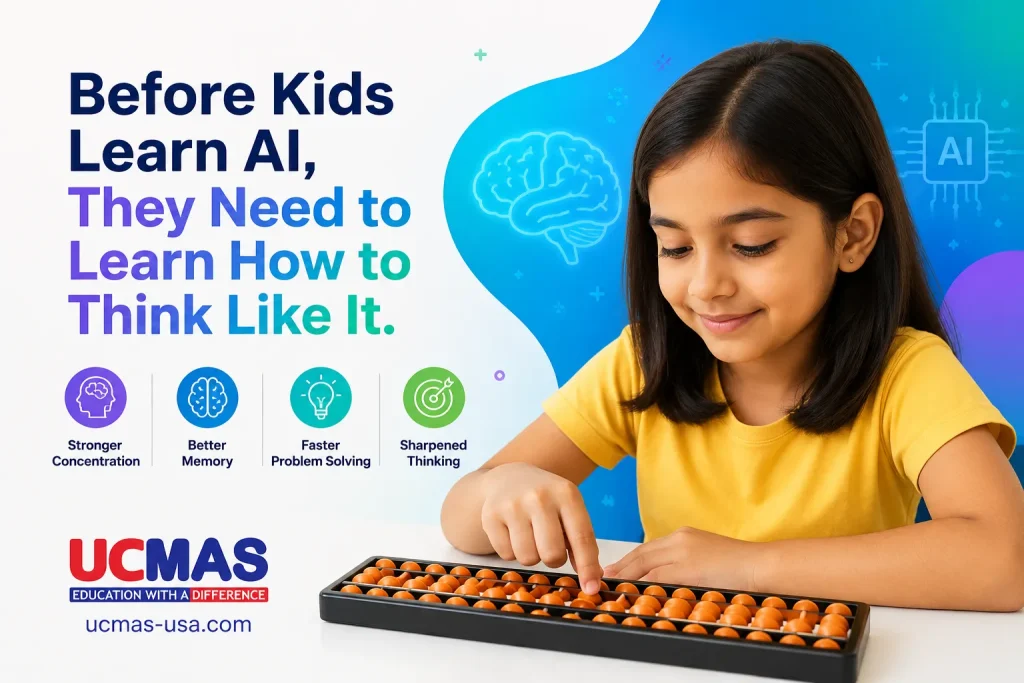
The Brain Is the Original AI Engine
Artificial Intelligence processes information by recognizing patterns and making calculations rapidly.
Children trained through an abacus math curriculum learn remarkably similar mental processes.
Instead of relying on calculators, students visualize beads in their minds while performing complex calculations. This activates multiple brain regions simultaneously, strengthening neural pathways responsible for memory, visualization, attention, and analytical reasoning.
Over time, children begin solving problems faster while developing confidence in their own thinking abilities.
Rather than replacing thinking with technology, abacus learning strengthens the brain that will eventually work alongside AI.
How Abacus Learning Builds Essential STEM Skills
1. Stronger Logical Thinking
Programming languages follow logical sequences.
Engineering relies on structured reasoning.
Mathematics depends on understanding relationships between numbers.
Abacus exercises train children to approach problems step by step, making logical thinking second nature.
2. Improved Visualization
Many STEM disciplines require students to mentally picture concepts before solving them.
Whether imagining geometric shapes, engineering models, graphs, or algorithms, visualization is essential.
Mental abacus calculations constantly exercise this skill, improving children’s ability to “see” solutions mentally before writing them.
3. Better Concentration
Modern classrooms are filled with distractions.
Students who can maintain attention for longer periods generally perform better in mathematics, science, and coding.
Regular abacus training strengthens sustained focus through structured mental exercises that demand continuous attention.
4. Faster Information Processing
In STEM education, solving problems efficiently often matters just as much as arriving at the correct answer.
Mental calculations encourage children to process numerical information quickly while maintaining accuracy—a valuable skill across mathematics, engineering, and computer science.
Why Mental Math Complements Coding Instead of Competing With It
Some parents wonder whether they should choose coding or mental math.
The better answer is both.
Coding teaches children how computers solve problems.
Mental math teaches children how humans solve problems.
Together, they create a powerful learning combination.
Children who possess stronger working memory and logical reasoning often find programming concepts easier because they can better understand sequences, conditions, variables, and algorithms.
As explained in Can Kids Be Trained to Think Faster?, improving cognitive processing speed enhances learning across many academic subjects—not just mathematics.
AI Will Reward Thinkers, Not Just Technology Users
As artificial intelligence becomes increasingly capable, future careers will place greater value on uniquely human abilities:
- Critical thinking
- Creativity
- Decision-making
- Adaptability
- Analytical reasoning
Technology can generate answers.
Humans must determine whether those answers make sense.
Children who develop strong mental reasoning early are likely to adapt more confidently to emerging technologies throughout their education and careers.
Abacus learning helps build exactly those foundational thinking habits.
Why More Families Are Investing in Cognitive STEM Preparation
Across the United States, parents are recognizing that academic success begins with cognitive development.
Interest in enrichment programs continues growing alongside opportunities within the stem education franchise USA sector, particularly as communities seek educational programs that strengthen thinking skills rather than simply increasing screen exposure.
Similarly, Why Texas Leads STEM Education Franchise Growth highlights how rising demand for high-quality STEM enrichment reflects changing parental priorities.
Instead of focusing only on coding, families increasingly value programs that improve how children think, learn, and solve problems.

Why UCMAS Continues to Stand Out
The abacus math program at UCMAS isn’t designed merely to improve arithmetic.
Its structured curriculum develops:
- Memory
- Concentration
- Visualization
- Confidence
- Analytical thinking
- Problem-solving
- Processing speed
These abilities support learning across mathematics, science, engineering, robotics, coding, and many future AI-related disciplines.
Parents interested in understanding the complete curriculum can explore the UCMAS Abacus Math Program to see how every learning stage contributes to stronger cognitive development.
The Best Investment Isn't Technology—It's Brain Development
Technology will continue evolving.
Artificial intelligence will become more sophisticated.
Programming languages will change.
But strong thinking skills remain timeless.
Children who learn how to analyze information, visualize solutions, stay focused, and solve problems independently will continue thriving regardless of how technology evolves.
That is precisely why abacus learning remains one of the smartest long-term investments parents can make.
Give Your Child a Stronger STEM Foundation
Preparing children for tomorrow means strengthening the skills they’ll rely on throughout life—not simply teaching the latest technology.
At UCMAS, children develop confidence, cognitive abilities, and lifelong learning habits that support success in STEM education and beyond.
Book a free information session today through the UCMAS Information Session Form and discover how abacus learning can help your child build the thinking skills needed for an AI-driven future.
FAQs
Abacus learning strengthens cognitive abilities such as logical reasoning, concentration, visualization, and problem-solving. These foundational skills help children adapt more effectively to AI-driven education, STEM subjects, and future careers.
Absolutely. While calculators provide answers instantly, abacus learning develops the brain’s ability to analyze, reason, and process information independently. These human thinking skills remain valuable regardless of technological advancements.
Abacus training improves logical thinking, analytical reasoning, visualization, memory, concentration, and faster information processing. These skills directly support success in mathematics, engineering, science, and computer programming.
Coding teaches children how technology works, while mental math classes strengthen the cognitive abilities needed to understand programming logic and solve problems effectively. Together, they provide a balanced STEM education.
Yes. Regular abacus practice encourages children to solve problems systematically, identify patterns, and think logically. These skills are essential across STEM disciplines and many real-world situations.
Both AI systems and abacus mental math involve recognizing patterns, processing information, and solving problems efficiently. While AI uses algorithms, abacus strengthens the human brain’s natural ability to think analytically.
They serve different but complementary purposes. Coding teaches technical skills, while abacus builds the mental foundation needed for logical reasoning, concentration, and problem-solving. Combining both provides children with a stronger STEM advantage.
Most children benefit from beginning between ages 4 and 13, when cognitive development is especially rapid. Starting early allows them to build stronger mental calculation, concentration, and reasoning skills before tackling more advanced STEM subjects.