

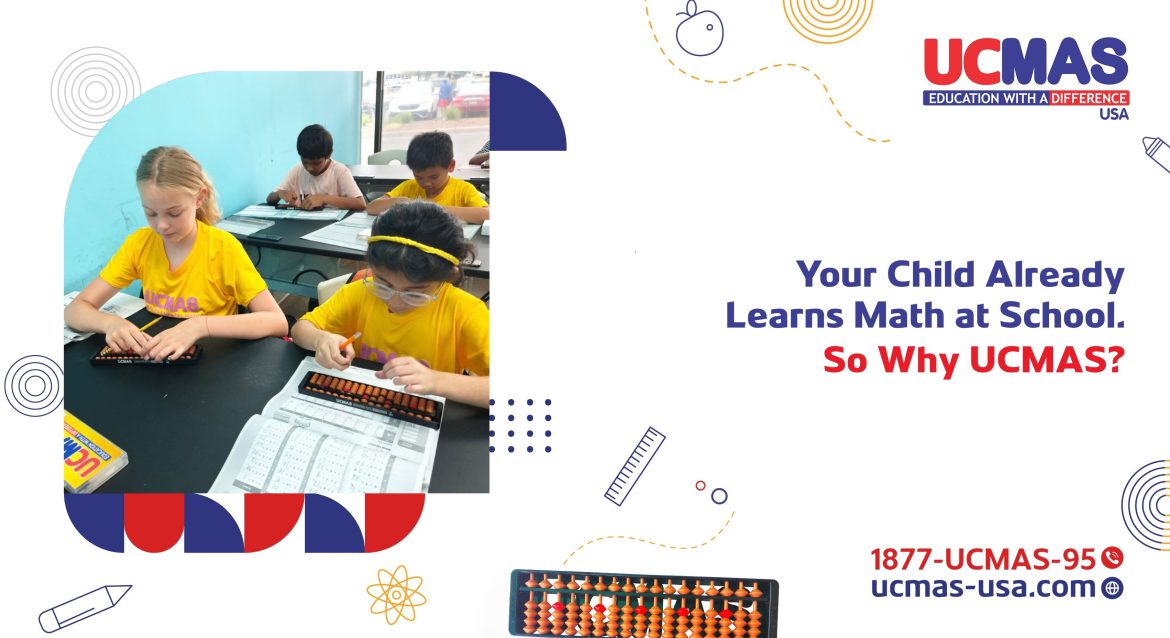
When parents first hear about UCMAS, a common question comes up: “If my child is already learning math at school, why do they need UCMAS?”
The answer starts with an important distinction: UCMAS is not intended to replace school math.
Schools follow an academic curriculum designed around grade-specific concepts, assessments, and educational standards. UCMAS approaches numbers from another direction. Through its structured abacus math program, children practise calculation, visualization, concentration, speed, accuracy, and mental processing.
Think of school math as teaching children what mathematical concepts they need to know, while UCMAS helps exercise some of the foundational abilities they use while working with those concepts.
That is why UCMAS can work alongside classroom education as math enrichment rather than competing with it.
So, what does that relationship look like as your child moves through elementary school?
Kindergarten and Grade 1: Making Numbers Feel Real
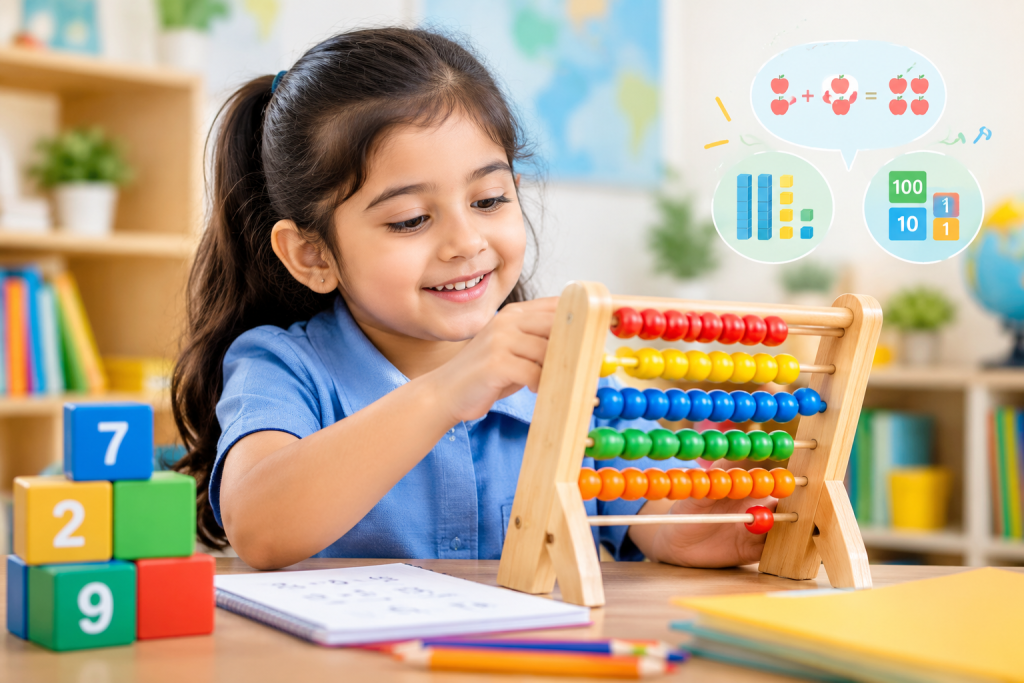
In the early years, math is about much more than getting an answer right. Children are beginning to understand what numbers actually represent.
They encounter counting, comparisons, simple addition and subtraction, patterns, and early place value concepts. At this stage, strong number sense becomes particularly important.
An abacus gives numbers a visual and tactile dimension. Instead of seeing “7 + 2” only as symbols on a worksheet, children manipulate beads and connect quantities with physical movements.
This is where abacus math for kids can complement the school math curriculum. It offers children another way to experience numbers without replacing the methods their teachers introduce.
As children progress, understanding tens, ones, hundreds, and eventually larger numbers becomes increasingly important. Parents can explore why place value plays such an important role in building a strong math foundation to understand how this early concept supports later learning.
Grades 2 and 3: Moving From “How” to “How Fluently?”
By Grades 2 and 3, children are expected to do more with the fundamentals they have learned.
Addition and subtraction become more complex, place value expands, and multiplication begins to play a bigger role. The challenge is no longer simply understanding an operation. Children also need increasing arithmetic fluency.
This is where a mental math program can provide useful supplemental education.
With continued abacus practice, children gradually learn to visualize the abacus and perform calculations mentally. The goal is not to teach a competing classroom method but to strengthen mental calculation through regular practice.
That can matter because gaps in foundational abilities may become more visible as math grows more demanding. Our guide to what parents may miss while building math skills in Grades 1–5 explores why developing the foundations deserves attention alongside completing homework and preparing for tests.
For a child who understands addition but works very slowly, for example, additional practice can help develop greater comfort with numbers.
Grades 4 and 5: When Math Starts Asking More of the Brain
By Grades 4 and 5, math often feels noticeably different.
Children are working with larger numbers and more advanced multiplication and division while encountering fractions, decimals, multi-step questions, and increasingly complex problem-solving.
At this point, a child may understand the concept but still spend significant mental effort on basic calculations.
Imagine solving a multi-step word problem while also struggling to calculate each smaller arithmetic step. The process can become frustrating even when the child understands what the question is asking.
This is where math enrichment for children can support the skills surrounding classroom work.
UCMAS encourages repeated mental arithmetic practice, visualization, concentration, and accuracy. As basic calculations become more familiar, children may be better positioned to direct their attention toward the larger problem.
Parents interested in this connection can read more about how abacus training can help children strengthen skills that support school performance.
So, Where Does UCMAS Fit Into School Math?
The simplest answer is: beside it, not instead of it.
A teacher may introduce multiplication using arrays, groups, number lines, or another curriculum-based strategy. UCMAS does not need to replace those approaches. Instead, children continue practising their ability to work with numbers efficiently through abacus-based exercises.
Similarly, school might teach place value as an academic concept, while abacus activities give children repeated opportunities to represent and manipulate numbers.
This is the relationship between abacus and school math: one provides the formal grade-level learning framework, while the other offers structured practice designed to develop complementary mental skills.
This distinction also explains why some schools adopt abacus and mental math programs as enrichment alongside their regular curriculum.
What About Children Who Are Already Good at Math?
A supplemental math program is not only for children who are struggling.
A child may already earn strong grades but still benefit from being challenged in different ways. Quick mental processing, sustained concentration, visualization, accuracy under time pressure, and confidence with numbers are skills that may continue developing beyond what a report card captures.
For these learners, UCMAS can provide a different kind of challenge rather than simply giving them more school worksheets.
And for children who find math difficult, the hands-on and visual nature of the abacus may provide another way to engage with numbers.
The objective in both cases is not to race ahead of the child’s grade-level math skills. It is to strengthen abilities that can support learning now and as mathematical demands increase.
Why Mental Math Matters Beyond One Grade
Children move from counting to arithmetic, from arithmetic to multi-step problems, and eventually toward increasingly abstract mathematics.
But one requirement keeps following them: they need to work with numbers.
When basic calculations demand too much attention, more complex tasks can feel heavier. Developing stronger mental arithmetic can help children become more comfortable handling numerical information.
That is why the formative years offer an important opportunity to develop these foundations. Learn more about why mental math is valuable during a child’s formative years.
Ultimately, the goal is not simply faster answers. It is helping children approach numbers with greater familiarity, focus, and confidence.
School Math and UCMAS Are Teammates, Not Competitors
Parents do not need to choose between school mathematics and UCMAS because they serve different purposes.
School remains responsible for teaching curriculum concepts appropriate to each grade. UCMAS provides a structured environment where children practise abacus techniques, visualization, mental arithmetic, concentration, and calculation skills.
From building number sense in the early grades to supporting greater arithmetic fluency as problems become more complex, UCMAS can grow alongside a child’s classroom learning.
The question, then, is not “Can UCMAS replace school math?”
A more useful question may be: “Could strengthening the skills behind calculation help my child get more from the math they are already learning?”
Explore UCMAS to learn more about how the program approaches abacus and mental math training.
Want to see how UCMAS could complement your child’s current math learning? Book a free UCMAS info session and discover how the program works.
Frequently Asked Questions
No. UCMAS is designed as an enrichment program that complements school mathematics by developing mental calculation, concentration, visualization, and arithmetic skills.
Abacus training gives children structured practice with numbers and calculations while school continues to teach grade-specific concepts and mathematical methods.
Children can begin abacus learning during their early formative years, although the appropriate starting point depends on their age, readiness, and the specific program level.
Abacus practice can support foundational skills such as number sense, addition, subtraction, multiplication, place value, and mental arithmetic that children use throughout elementary mathematics.
Mental math helps children practise working with numbers without relying on written calculations for every step, supporting greater familiarity and fluency with arithmetic.
Yes. The visual structure of an abacus can help children represent quantities and place values while structured practice can reinforce arithmetic operations, including multiplication.
Yes. Children who already do well in mathematics can use UCMAS as additional enrichment that challenges their speed, accuracy, visualization, concentration, and mental calculation abilities.
Parents can visit the UCMAS USA website to explore the program and find information about available UCMAS learning opportunities in their area.