

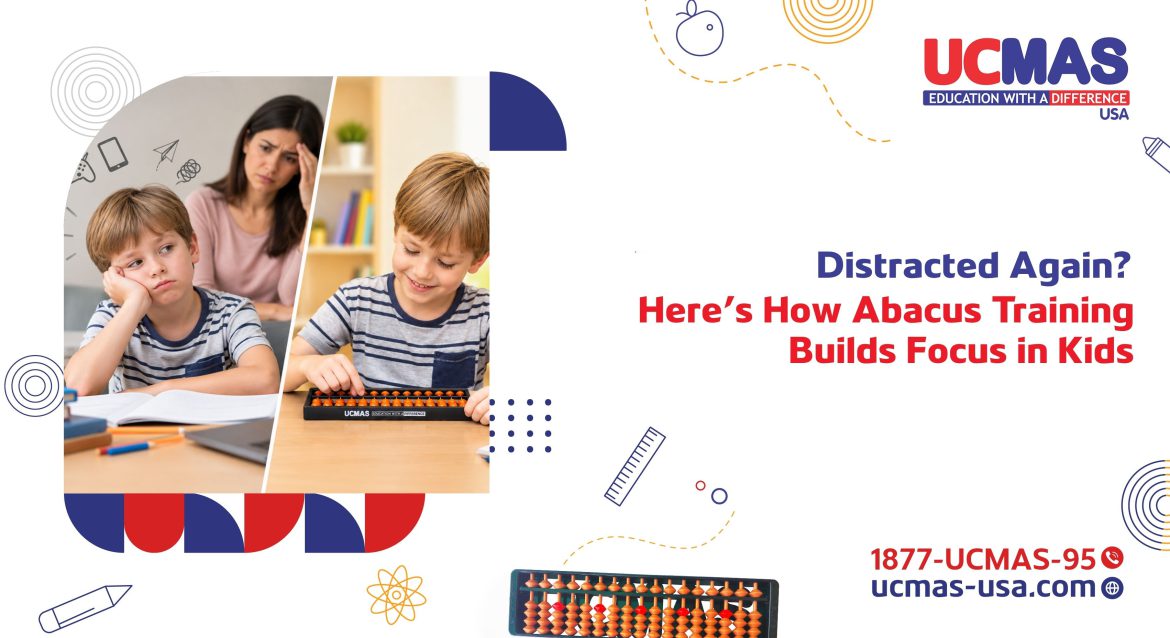
“Please concentrate.”
“Finish this first.”
“Stop getting distracted.”
If these phrases sound familiar, you are certainly not the only parent wondering how to help a child stay focused. Children can lose attention during homework, forget instructions midway through a task, or jump from one activity to another before finishing.
While every child is different, concentration is also a skill that can be practiced. The right activities can encourage children to stay mentally engaged for longer periods and become more deliberate about how they approach a task.
That is where UCMAS comes in. Through structured abacus training and mental arithmetic, children engage in activities that require them to look, listen, calculate, remember, and respond. Instead of simply being told to focus, they get opportunities to actively practice it.
So, can an abacus really help a child who struggles with concentration? Let’s understand what happens when those colorful beads start moving.
Why Do Some Children Find It Difficult to Concentrate?

A child’s attention span can vary depending on age, interest, environment, task difficulty, sleep, and many other factors. In a world filled with fast-moving digital entertainment and constant stimulation, slower learning activities can sometimes feel less immediately engaging.
Parents may notice their child rushing through work, forgetting steps, making avoidable mistakes, or needing frequent reminders to return to a task.
This does not automatically mean something is wrong. However, children can benefit from structured activities that encourage sustained engagement. UCMAS explores this further in its guide on why abacus builds attention span in the TikTok generation, explaining how active mental engagement differs from passive screen consumption.
How Does Abacus Training Exercise Focus?
Abacus learning is not simply about moving beads quickly or finding answers to arithmetic problems. A child must follow a sequence, recognize numbers, move the correct beads, remember intermediate steps, and arrive at an answer.
That means attention matters throughout the process.
During abacus learning for children, losing track for even a moment can interrupt a calculation. With repeated practice, children are encouraged to remain attentive from the beginning of a problem to the end.
This makes the activity different from simply telling a child, “Concentrate harder.” The task itself requires concentration.
For parents looking for practical focus activities for kids, this kind of structured practice can provide a clear goal, immediate feedback, and gradually increasing challenges.
From Physical Beads to Mental Visualization
One of the most interesting stages of abacus learning happens when children begin moving beyond the physical tool.
After developing familiarity with the abacus, students can learn to visualize its beads mentally and perform calculations using that imagined representation. This combines visualization with mental calculation and requires sustained attention.
The child is no longer simply remembering an answer. They must hold information in mind, manipulate it, and follow the calculation.
This connection between mental math and concentration is also one reason abacus practice can engage working memory and other cognitive skills. For a broader look at activities that exercise memory, parents can explore these smart activities to improve child memory.
What Skills Are Children Practicing Along the Way?
Better concentration is not necessarily developed through one isolated “focus exercise.” It can emerge through activities that repeatedly ask children to use several skills together.
Abacus for kids can involve listening carefully, recognizing numbers, recalling rules, coordinating hand movements, calculating accurately, and checking answers. As problems become more challenging, children also exercise problem-solving skills and develop stronger number sense.
These abilities can support better learning habits because children become accustomed to following processes rather than rushing immediately toward an answer.
Abacus practice is therefore about much more than arithmetic. If you are wondering whether your child could benefit from broader skill-building activities, these signs your child may need brain skill training can provide additional perspective.
Can Better Focus Carry Over to Schoolwork?
This is often the question parents care about most.
Abacus practice cannot guarantee that a child will suddenly become perfectly attentive during every lesson or homework session. However, repeatedly completing structured tasks that demand attention can give children opportunities to practice concentration skills for children in a consistent environment.
There is another practical advantage: progress is visible.
Children can see themselves solving problems they previously found difficult. As their familiarity increases, tasks may feel less overwhelming, potentially making it easier for them to remain engaged rather than giving up quickly.
For children who also struggle with mathematics, understanding how abacus training can help kids excel in math can help parents see how arithmetic practice and broader skill development can work together.
How Much Practice Does a Child Need?
More practice is not always better. Consistency matters more than turning abacus learning into another exhausting obligation.
Short, regular practice sessions can be easier for children to manage than occasional long sessions. The appropriate duration depends on the child’s age, experience, and program guidance.
Parents can also create a distraction-light environment during practice. Put unnecessary devices away, choose a consistent study space, and allow the child to focus on one task at a time.
Most importantly, avoid treating every lapse in child concentration as failure. The objective is to gradually build the habit of returning attention to the task.
Is Abacus Right for Every Child Who Struggles With Focus?
Children learn differently, so no single activity is a universal solution. Abacus training can be particularly engaging for children who respond well to hands-on activities, numbers, patterns, challenges, and visual learning.
Parents should also distinguish everyday distractibility from persistent concentration difficulties that significantly affect a child’s daily functioning or learning. In those situations, abacus classes can be an enrichment activity, but they should not be treated as a substitute for appropriate professional guidance.
If you are comparing enrichment options, this guide on how to find the best brain development program for your child can help you consider factors beyond academics alone.
Building Focus One Calculation at a Time
Children are rarely born knowing how to sit through every challenging task without getting distracted. Focus develops through experience, routines, practice, and opportunities to complete tasks that demand sustained mental effort.
Abacus learning creates those opportunities in an interactive way. As children work with beads and eventually visualize calculations mentally, they are encouraged to pay attention, remember steps, think accurately, and persist until they reach an answer.
At UCMAS, the goal extends beyond faster arithmetic. The program uses mental math activities to engage young minds and help children practice skills that can support their broader learning journey.
Wondering whether the program could be a good fit for your child? Register for a UCMAS information session to learn more about the program, its approach, and available classes.
Frequently Asked Questions
Abacus practice requires children to follow calculations carefully and remain engaged through multiple steps, giving them regular opportunities to exercise concentration.
Children need to listen, visualize, remember steps, move beads accurately, and calculate, making sustained attention an active part of the exercise.
The appropriate starting age depends on the individual program and child’s readiness. Parents should check the age requirements of their chosen UCMAS program or center.
Mental math asks children to hold and manipulate information while solving problems, engaging attention and working memory during the activity.
Short, consistent sessions are generally more manageable than lengthy practice. Parents should follow their instructor’s recommendations based on the child’s age and learning level.
It can be a useful enrichment activity because the exercises encourage active participation and sustained attention. However, persistent or significant concentration difficulties may warrant professional assessment.
Abacus practice may help children exercise habits such as staying with a task and following sequential steps, but it cannot guarantee distraction-free homework.
Parents can visit the UCMAS USA website to explore program information and connect with UCMAS to find suitable classes or centers in their area.