

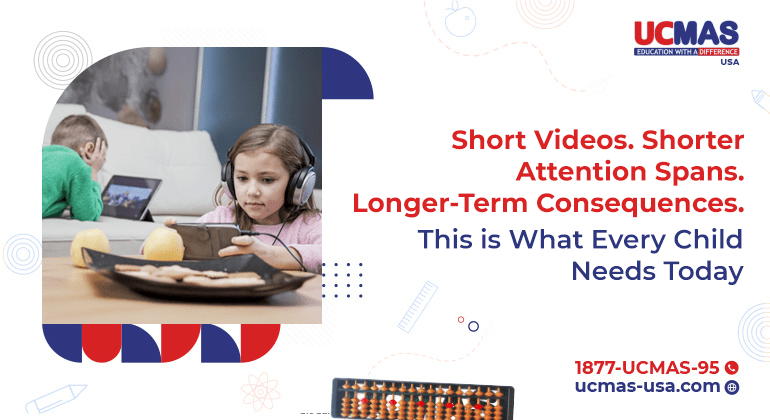
If you’re a parent today, this probably sounds familiar: your child is smart, curious, and quick—but struggles to sit with one task for long. Homework takes forever, reading feels like a chore, and the moment things get slightly challenging, attention drifts.
Welcome to parenting in the TikTok era.
Children today are growing up in a world of constant stimulation. Short videos, instant entertainment, and endless scrolling are shaping how young brains process focus. And this is exactly why programs like UCMAS are becoming more relevant than ever—not just for math skills, but for building attention itself.
Let’s explore why the abacus is no longer “extra learning,” but a necessary foundation for focus in the digital age.

The Attention Span Crisis in Digital-Age Children
Before we look at solutions, it’s important to understand what’s actually happening to children’s attention spans today.
What “Reduced Attention Span” Really Looks Like
This isn’t about children being disinterested or lazy. It shows up in subtle ways—difficulty finishing tasks, getting distracted midway, or feeling mentally tired very quickly. Many parents are actively searching for children’s attention span activities because they can see that traditional studying isn’t enough anymore.
The connection between screen time and attention span is becoming harder to ignore. When screens dominate free time, the brain adapts to constant novelty instead of sustained effort.
Why Parents Are Seeing This First
Teachers work within structured classrooms. At home, parents see the raw reality—kids jumping between tasks, losing patience quickly, or reaching for a screen whenever something feels slow. This often leads parents to ask an important question: Are screens helping or hurting my child’s learning?
If you’re exploring this concern, this guide on whether screens are helping or hurting children’s learning offers a deeper look at how digital habits influence focus and cognitive development.
How Short-Form Content Is Rewiring Focus
Short videos aren’t the villain—but they are powerful.
The 15-Second Attention Loop
Platforms built around short-form content train the brain to expect quick rewards. Swipe, watch, swipe again. Over time, this reduces tolerance for effort-based activities like reading, writing, or solving multi-step problems, which is a significant screen time impact on learning.
Dopamine vs Discipline
Quick content delivers instant satisfaction. Learning doesn’t. When children become accustomed to immediate stimulation, their brains resist tasks that require patience. This is where many parents notice that even academically capable children struggle to concentrate deeply.
The Hidden Learning Cost
Reduced focus doesn’t just affect grades. It impacts listening skills, comprehension, memory retention, and emotional regulation—all essential skills to improve concentration.
Why Academic Performance Doesn’t Equal Attention Training
This is where many parents get confused.
“My Child Is Good at Math—So Focus Isn’t the Issue”
Good marks don’t always mean strong focus. Many children rely on pattern recognition or memorization. On the contrary, mental math and focus for kids requires sustained concentration, mental visualization, and discipline—skills that go beyond worksheets.
Tuition Classes vs Cognitive Skill-Building
Most tuition classes are outcome-driven. Tasks are short, guided, and answer-focused. They rarely train children to stay mentally engaged for longer durations, which is why many parents start looking for ways to improve focus in children naturally.
How Abacus Builds Sustained Concentration
Abacus works because it trains the brain, not just the fingers.
One Tool, Complete Attention
Using an abacus requires the child’s eyes, hands, and mind to work together. There’s no passive learning. This full engagement is why the abacus is highly effective for attention span development.
Visualization Builds Mental Discipline
As children transition from physical beads to mental imagery, they learn to hold numbers in their minds while calculating. This strengthens working memory and is one of the most powerful abacus benefits for concentration.
Abacus & Mental Math Teacher Training
Training begins with abacus fundamentals and gradually moves into mental math techniques. Franchise partners learn how children transition from physical abacus usage to visualization-based calculations.
This structured approach ensures consistency across all UCMAS centers worldwide.
Focus Under Gentle Pressure
Abacus practice is time-bound but structured. Children learn to stay calm, accurate, and focused—skills that naturally transfer to exams and everyday problem-solving.
Consistency Without Burnout
Unlike rote practice, the abacus challenges the brain without overwhelming it. When combined with small daily habits, it makes a big difference for children by improving their focus steadily and sustainably.
Real-World Benefits Beyond Math
The biggest advantage of abacus shows up outside of math class.
Stronger Classroom Attention
Children trained in abacus often listen longer, follow instructions better, and remain mentally present during lessons.

Better Emotional Control
Improved focus also means better emotional regulation. Children handle mistakes calmly and approach challenges with confidence instead of frustration.
Focus That Carries Into Daily Life
From reading longer books to completing homework independently, abacus helps children build habits that support learning across subjects—not just math.
Why Abacus Matters More Than Ever
In a world designed for distraction, focus has become a life skill. Problem-solving, decision-making, and adaptability are all important skills that require sustained focus. Children who learn to concentrate early are better prepared for future academic and life challenges.
The goal isn’t to remove technology—it’s to build cognitive resilience. Abacus provides that balance by strengthening attention from the inside out.
Focus Is a Skill and It Can Be Trained
Attention span isn’t something children are born with or without. It’s a skill that develops with the right kind of training. Abacus offers a proven, structured way to build focus, discipline, and mental clarity—especially in today’s digital world.
If you’re looking for a program that strengthens concentration while building confidence and mental math ability, explore how UCMAS supports whole-brain development in children.
Ready to Help Your Child Build Real Focus?
Give your child the tools to concentrate, think clearly, and thrive—inside and outside the classroom.
Book an info session at UCMAS today to learn how you can make focus their superpower.
FAQs
Abacus requires children to focus continuously while visualizing numbers and solving problems, which naturally strengthens sustained concentration and mental discipline over time.
Yes, abacus is one of the most effective ways to counter the effects of excessive screen time by training the brain to stay engaged without constant stimulation.
Children can begin abacus as early as 4–5 years old, when attention-building activities are most effective for long-term cognitive development.
While abacus builds strong mental math skills, its biggest benefit is improved focus, memory, and concentration skills that carry over to all subjects.
Yes, regular abacus practice helps children stay attentive for longer periods, follow instructions better, and handle classroom tasks with more confidence.
Unlike passive activities, abacus actively engages the mind, hands, and eyes together, making it a powerful way to improve focus in children naturally.