

In classrooms across North Carolina, from academic hubs to growing education centers in Charlotte, educators are rethinking what truly drives student success. It’s no longer just about grades or standardized testing; it’s about how effectively children learn and retain information.
One skill quietly making a powerful impact is mental math.
While often associated with quick calculations, mental math goes far deeper. It strengthens the brain’s ability to process, store, and retrieve information, making it a key contributor to memory retention, the core of all learning.
North Carolina has long emphasized early cognitive development for kids through initiatives like the Carolina Abecedarian Project, proving that the right mental stimulation in early years leads to long-term academic success. Mental math aligns perfectly with this philosophy.
So, how does this simple practice transform the way children remember and learn? Let’s explore.
What is Mental Math?
Mental math is the ability to solve mathematical problems entirely in the mind, without the use of paper, calculators, or digital tools. But beyond its definition, it represents a way of thinking, one that builds flexibility, confidence, and strong cognitive skills in children.
What many parents may not realize is that mental math doesn’t usually begin in the mind alone. It often starts with a structured, visual learning tool like the abacus, especially in mental math programs.
In the early stages, children use a physical abacus to perform calculations. This helps them understand numbers tangibly and visually. As they practice, they begin to visualize the abacus in their mind, gradually transitioning from physical movement to mental calculation. This shift is what transforms abacus learners into confident mental math thinkers.
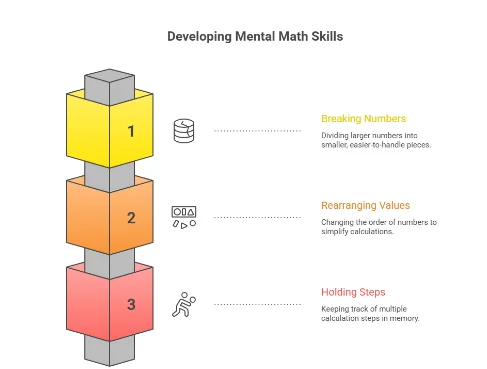
For instance, instead of mechanically solving a problem, your child begins to see patterns and relationships between numbers. They might simplify a calculation by adjusting numbers mentally or grouping values in a way that feels intuitive.
This flexibility moves them away from rote memorization and toward true understanding. Over time, math stops being just a subject to study and becomes a mental exercise that strengthens the brain.
How Mental Math Works on Your Child’s Brain
Mental math might look like a simple classroom exercise, but inside your child’s brain, it’s a full workout. Unlike written calculations, where steps are offloaded onto paper, mental math forces the brain to do everything internally, hold information, process it, and arrive at an answer, all at once.
This is what makes it so powerful for cognitive development. It doesn’t just teach children how to calculate; it teaches their brains how to think, organize, and remember more effectively.
Strengthening Working Memory
At the core of mental math is working memory, the brain’s ability to temporarily hold and manipulate information. Think of it as a mental notepad that your child uses to keep track of numbers while solving a problem.
When a child tries to solve something like 47 + 36 in their head, they are not just adding numbers. They are:
- Holding 47 in their mind
- Breaking 36 into smaller parts
- Adding step by step while remembering previous results
With regular practice, this “mental notepad” becomes stronger and more efficient. Children get better at holding more information at once and using it effectively. Over time, this improvement spills over into other areas, such as reading comprehension, following instructions, and even remembering what was taught in class.
In simple terms, mental math trains the brain to hold onto information longer and use it smarter.
Building Stronger Neural Connections
Every time your child solves a math problem mentally, their brain is building connections between neurons. These connections are like pathways; each time they are used, they become stronger and faster.
At first, solving problems mentally may feel slow or challenging. That’s because these pathways are still developing. But with consistent practice, the brain begins to recognize patterns and shortcuts.
For example, a child who repeatedly practices mental math will eventually stop “calculating” basic sums and start instantly recalling them. This is because the brain has strengthened those pathways enough to make retrieval automatic.
This process is similar to learning to ride a bicycle. In the beginning, every movement requires effort and focus. Over time, it becomes second nature. The same happens with memory. Stronger neural connections mean:
- Faster recall
- Less forgetting
- Better retention of learned concepts
Mental math, therefore, doesn’t just improve speed; it builds a brain that is wired for remembering.
Engaging Both Sides of the Brain
One of the most fascinating aspects of mental math is how it engages different parts of the brain at the same time. When children solve problems mentally, they often:
- “Talk” themselves through the steps internally (verbal processing)
- Visualize numbers, patterns, or number lines (visual processing)
For instance, a child might imagine breaking a number into parts or picture numbers moving along a mental number line. At the same time, they may be silently guiding themselves through the steps.
This combination activates both the left and right sides of the brain:
- The left side supports logic, language, and structured thinking
- The right side supports visualization, patterns, and creativity
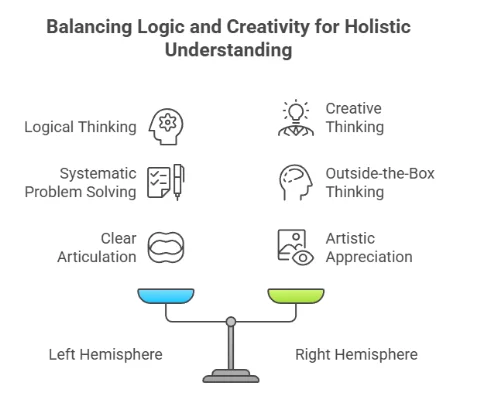
When both sides work together, learning becomes deeper and more connected. Instead of memorizing isolated facts, children build a network of understanding.
A Balanced Brain Workout
What makes mental math truly powerful is that it doesn’t rely on just one cognitive skill. It combines memory, attention, visualization, and reasoning into a single activity.
Over time, this creates a more balanced and efficient brain. Children become better at:
- Concentrating for longer periods
- Processing information quickly
- Switching between different types of thinking
And most importantly, they become better at retaining what they learn.
In a world where children often rely on calculators and screens, mental math brings the focus back to the brain itself. It encourages children to trust their thinking, strengthen their memory, and develop skills that go far beyond mathematics.
How Mental Math Improves Memory Retention
Active Recall Strengthens Memory
Mental math naturally encourages active recall—the process of retrieving information from memory rather than recognizing it. Each time a child solves a problem mentally, they are reinforcing their ability to access stored knowledge. This repeated retrieval strengthens memory pathways, making it easier to recall information in the future.
Repetition Without Monotony
One of the biggest challenges in learning is maintaining consistent practice. Mental math overcomes this by being engaging and dynamic.
Because it often feels like a challenge or game, children practice more frequently without feeling bored. This consistent repetition helps transfer knowledge from short-term memory to long-term storage.
Faster Processing, Better Retention
As children become more comfortable with mental math, their ability to process information improves. They begin to recognize patterns quickly and arrive at answers with less effort. This efficiency reduces cognitive strain, allowing the brain to focus on understanding and retaining more complex concepts.
Reduced Cognitive Overload
When basic calculations become automatic, the brain no longer needs to spend excessive energy on simple tasks. This frees up mental space for deeper thinking and learning. As a result, children are better able to retain and apply new information.
Why Memory Retention is Crucial for School Children
Academic Performance and Understanding
Memory retention is essential for academic success. Children need to remember concepts, apply them, and build upon them over time. Without a strong memory, learning becomes fragmented and inconsistent.
In structured school systems across North Carolina, where students are expected to handle multi-step problems and timed assessments, strong memory retention provides a clear advantage.
Confidence in the Classroom
Children who can recall information easily tend to be more confident. They participate more actively, answer questions without hesitation, and engage more deeply with lessons. This confidence plays a significant role in overall academic development.
Long-Term Learning and Adaptability
Strong memory retention doesn’t just help in school; it builds lifelong learning skills. Children become better at absorbing new information, adapting to new challenges, and retaining knowledge over time.
Additional Benefits of Mental Math
Improved Focus and Attention
Mental math requires children to concentrate fully, without relying on external tools. This strengthens their ability to focus, which benefits all areas of learning.
Enhanced Problem-Solving Skills
By encouraging children to break problems into smaller parts and approach them creatively, mental math develops strong analytical thinking skills.
Stronger Number Sense
Children begin to understand numbers more intuitively. They can estimate, compare, and manipulate values with ease, building a solid mathematical foundation.
Greater Independence in Learning
Without the need for calculators or written methods, children learn to rely on their own reasoning. This independence fosters confidence and self-reliance.
Tips to Bring Mental Math Into Everyday Life
- Turn everyday situations into quick math moments. While shopping, ask your child to estimate the total bill or calculate discounts mentally.
- Use travel time wisely. During car rides, engage them with quick addition or pattern-based questions.
- Encourage “thinking aloud.” When children explain their steps, it strengthens both understanding and memory retention.
- Break numbers into smaller, friendly chunks. This makes problems feel easier and builds flexible thinking skills.
- Use worksheets strategically. Short, well-designed mental math worksheets can reinforce concepts and provide structured practice without overwhelming the child.
- Turn it into a game. Timed challenges or rapid-fire questions keep children engaged and motivated.
- Involve real-life decisions. Simple questions like calculating total costs or splitting items make math practical and relatable.
Shape Brighter Minds with Mental Math & UCMAS
Mental math is more than just a mathematical skill; it is a powerful tool for cognitive development for kids. By strengthening working memory, encouraging active recall, and improving processing efficiency, it plays a crucial role in enhancing memory retention. For children across North Carolina, this skill offers far-reaching benefits. It supports academic success, builds confidence, and prepares them for future challenges in an increasingly competitive learning environment.
This is where programs like UCMAS play a transformative role. Designed specifically to enhance mental math and overall brain development, UCMAS goes beyond traditional learning by activating both sides of the brain, helping children improve concentration, visualization, and memory retention in a structured way.
With strategically located UCMAS centres across key cities, parents have greater access to specialized training that complements school education. These centres provide a consistent environment where children can regularly practice mental math, ensuring long-term cognitive growth.
Ready to unlock your child’s full potential?
Give them the advantage of sharper memory, stronger focus, and faster thinking with UCMAS. Visit your nearest centre in North Carolina and discover how structured mental math training can transform the way your child learns.
Enroll today and take the first step toward confident, independent learning!
Frequently Asked Questions (FAQs)
Most children can begin mental math training as early as ages 4–6, when their brains are highly receptive to learning new cognitive skills. Programs like UCMAS are specifically designed to suit these early developmental stages.
Yes, mental math enhances concentration, problem-solving, and recall ability. These skills directly affect academic performance, especially in structured learning environments such as schools across North Carolina.
Not at all. When taught through structured and engaging methods, mental math becomes enjoyable. Children often see it as a fun challenge rather than a difficult task.
UCMAS focuses on overall brain training and development using abacus-based techniques. It goes beyond traditional math by improving memory, concentration, visualization, and cognitive speed.
Consistency matters more than duration. Short daily practice sessions—whether at home or at centres in cities like Raleigh or Charlotte—can significantly improve memory retention and cognitive skills over time.
Yes, regular mental math practice helps children rely more on their own thinking rather than external tools. Programs like UCMAS train children to visualize and calculate mentally, building confidence and independence while strengthening their cognitive abilities.
Yes. Mental math strengthens working memory by requiring children to hold, process, and manipulate numbers in their minds, leading to better recall, focus, and overall learning ability.
Yes. Many learning centers offer programs focused on memory enhancement through mental math, abacus training, and cognitive exercises. Choose structured programs that build skills progressively.
Effective techniques include visualization, chunking information, repetition, association, mind mapping, and regular mental math practice. These methods help children retain and recall information more easily.
Abacus training engages both sides of the brain. Children start with a physical tool and gradually visualize it mentally, improving concentration, memory, visualization, and analytical thinking.
Children can begin as early as 5–7 years old, a stage when the brain is highly adaptable and capable of developing strong cognitive foundations.
Most children show noticeable improvements in concentration, speed, and recall within 3–6 months, with stronger long-term cognitive benefits over time.
Mental math, abacus visualization, puzzles, memory games, reading, and pattern recognition are highly effective in strengthening memory, focus, and problem-solving skills.