

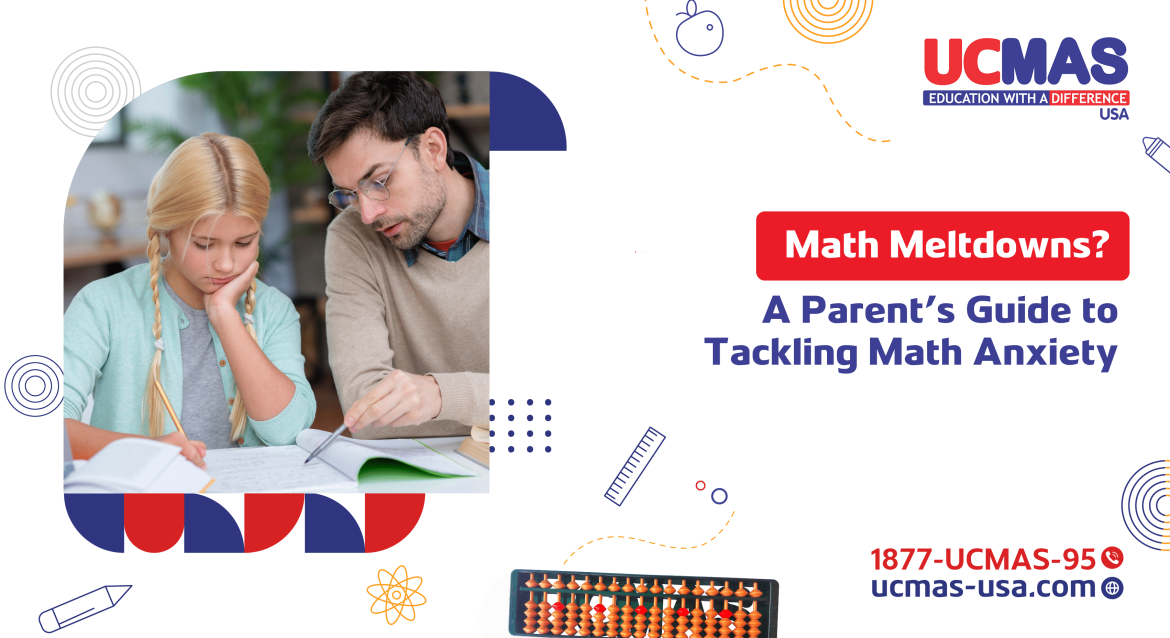
For some children, math is more than just another school subject. A simple worksheet can trigger frustration, a test can cause panic, and even the mention of homework can lead to tears or avoidance. When these reactions become frequent, parents may begin to wonder whether their child is experiencing math anxiety.
Math anxiety is more than simply disliking math or finding a particular topic difficult. It is a feeling of worry, fear, or tension associated with mathematics that can interfere with a child’s ability to concentrate, solve problems, and demonstrate what they know. For some children, this anxiety can create a cycle in which fear leads to avoidance, avoidance limits practice, and limited practice further reduces confidence.
For parents, one of the most important things to understand is that the way you talk about math can influence how your child feels about it. A conversation intended to provide reassurance can sometimes create more pressure if it focuses too heavily on grades, comparisons, or the idea that math should be easy.
So, how to talk to your child about math anxiety without making it worse? The answer begins with understanding, patience, and the right kind of support.
Recognizing the Signs of Math Anxiety
Before starting a conversation, it helps to recognize what math anxiety may look like. Not every child will openly say, “I’m anxious about math.” Instead, anxiety may appear as frustration, avoidance, or a sudden lack of confidence.
Your child may regularly say things such as,
|
Some children may also experience physical signs of stress, such as restlessness, tension, headaches, or stomach discomfort. Others may simply shut down and refuse to participate.
It is important to distinguish occasional frustration from persistent anxiety. Finding a difficult math problem frustrating is normal. However, when fear repeatedly affects your child’s willingness to participate, confidence, or academic performance, it deserves attention.
Start the Conversation by Listening
When your child says, “I hate math,” your first instinct may be to solve the problem. You might immediately explain the concept, encourage them to practice, or remind them that math is important.
Instead, start by listening. Ask open-ended questions to understand what is really causing your child’s discomfort with math. Is it homework, tests, time pressure, a particular topic, or fear of making mistakes? Perhaps they feel embarrassed when answering questions in class or worry that their classmates understand math faster than they do. Identifying the specific trigger can help you provide the right kind of support. |
Simple questions can open the conversation: “What part of math feels hardest for you?” “When do you start feeling nervous about math?” “Do you feel worried before a test or while you’re taking it?” and “What would make math feel easier?”
Give your child time to answer. You do not need to have an immediate solution. Sometimes, the most valuable thing a parent can communicate is, “I hear you, and I’m here to help.”
The Do's and Don'ts of Talking About Math Anxiety

The right conversation can help your child feel supported, while the wrong approach can unintentionally increase pressure. Keep these simple do’s and don’ts in mind.
Do: Listen Before You Give Advice
Give your child an opportunity to explain what they are experiencing. Ask questions and listen without immediately correcting them or offering solutions.
Try: “Tell me what happens when you start feeling nervous about math.”
This helps you understand whether the problem is related to specific concepts, tests, time pressure, mistakes, or confidence.
Don't: Dismiss Their Feelings
Avoid saying, “It’s only math,” “There’s nothing to worry about,” or “Just relax.” Although these statements are usually meant to reassure, they can make children feel that their concerns are not being taken seriously.
Instead: “I can see that math is making you feel worried. Let’s work out what is making it difficult.”
Do: Focus on Progress
Praise effort, persistence, and problem-solving strategies rather than simply celebrating correct answers.
Try: “You didn’t give up when that problem was difficult. You tried another way.”
This helps children understand that mathematical ability can develop through practice and learning.
Don't: Label Your Child
Avoid statements such as, “You’re not a math person,” or repeatedly describing your child as having “math anxiety.”
A child should not feel that difficulty with math defines who they are.
Instead: Say, “You’re finding this topic difficult right now, but we can work on it.”
Do: Normalize Mistakes
Make it clear that mistakes are a normal part of learning. Ask your child to explain their thinking so you can identify where they became confused.
Try: “Let’s see where the answer changed. Walk me through what you did.”
Don't: Shame or Compare
Avoid comparing your child with siblings, classmates, or friends. Statements such as “Your sister understands this easily” can make anxiety and self-doubt worse.
Instead: Compare your child’s progress with their own previous performance. “You understood this much faster than you did last week.”
Do: Create a Calm Learning Environment
Keep your tone calm when helping with homework. If your child becomes overwhelmed, take a short break instead of turning the situation into an argument.
Short, manageable practice sessions can be more productive than forcing a child to continue when they are already distressed.
Don't: Make Grades the Only Goal
Grades matter, but making them the primary focus can increase performance pressure.
Instead of asking, “Did you get an A?” ask, “What did you learn today?” or “Which part feels easier now?”
This shifts the focus from performance to progress.
Do: Talk Positively About Your Own Math Experiences
Children often notice how parents talk about mathematics. If you regularly say, “I was terrible at math,” your child may interpret this as evidence that mathematical ability is fixed.
Instead, if you struggled with math yourself, frame the experience around learning.
Try: “Math wasn’t always easy for me, but I learned that practicing and trying different approaches helped.”
Don't: Do the Work for Them
When your child is struggling, it can be tempting to give them the answer just to keep things moving. However, repeatedly taking over can reduce their confidence in their own ability.
Instead, offer a hint, ask a guiding question, or encourage them to explain what they already understand.
Do: Teach Your Child the 3-3-3 Method
When anxiety rises, it can become difficult for children to think clearly. Before asking your child to return to a difficult math problem, help them calm down and reconnect with the present moment.
One simple grounding technique parents can introduce is the 3-3-3 method.
First, ask your child to identify three things they can see. They might name their pencil, notebook, and window.
Next, ask them to identify three things they can hear, such as a fan, a car outside, or someone talking.
Finally, ask them to move three parts of their body, such as wiggling their fingers, rolling their shoulders, or moving their feet.
The technique provides a brief pause from anxious thoughts and helps redirect attention toward the present moment. It is not a treatment for anxiety, but it can be a simple grounding strategy that children can learn and practice.
Try practicing the 3-3-3 method when your child is calm rather than introducing it during a stressful math test. With repetition, it can become a familiar tool your child knows how to use when they notice anxiety building.
Don't: Let Homework Become a Daily Battle
When a child is anxious about math, long and stressful homework sessions can strengthen the negative association with the subject. If every math session ends with frustration, arguments, or tears, your child may begin to associate mathematics with conflict before they even open the book.
Break larger assignments into manageable sections and allow short breaks when appropriate. Starting with a few problems your child can reasonably solve can also help rebuild confidence before moving to more challenging material.
The objective is not to remove every challenge. Children need appropriate challenges to develop their skills. The goal is to prevent frustration from becoming so overwhelming that the child stops engaging altogether.
Do: Help Your Child See Math Beyond the Classroom
Children may develop anxiety because they see math as a collection of worksheets, formulas, and tests. Showing them how mathematics appears in everyday life can make the subject feel more practical and approachable.
Cooking involves measurements and fractions. Shopping involves prices, comparisons, discounts, and budgeting. Sports involve scores, statistics, timing, and distance. Travel involves time, estimation, and planning. Games involve patterns, strategy, counting, and probability.
These everyday experiences provide opportunities to use mathematical thinking without the pressure of a formal assignment.
Do: Address the Skill Gap, Not Just the Anxiety
Emotional support is important, but parents should also consider whether anxiety is connected to a genuine gap in mathematical understanding.
A child who repeatedly struggles with multiplication, fractions, place value, or basic calculations may become anxious because they do not feel confident with the underlying concepts. In this situation, simply telling them to “be confident” will not solve the problem.
They may need additional instruction, more practice, or a different approach to learning.
Structured programs such as abacus and mental math can provide children with progressive opportunities to work with numbers while developing skills such as concentration, memory, visualization, and calculation. The right learning environment should focus on building understanding and confidence rather than creating unnecessary pressure or comparison.
When Should You Seek Additional Support?
If your child’s math anxiety is persistent and begins affecting homework, tests, classroom participation, confidence, or overall well-being, it is worth seeking additional support.
Start by speaking with the teacher. Understanding what happens in the classroom can help determine whether the issue is related to specific mathematical concepts, test conditions, time pressure, classroom experiences, or broader anxiety.
It is also important to remember that math anxiety and a learning difficulty are not necessarily the same thing. A child may understand mathematical concepts but become extremely anxious during tests, while another child may need additional academic support because they are struggling with foundational skills.
If anxiety is severe, persistent, or extends beyond mathematics, a qualified professional can help determine what type of support may be appropriate.
Build Math Confidence With UCMAS

Building confidence often requires both emotional support and opportunities to experience success. UCMAS uses a structured abacus and mental math approach that gives children progressive opportunities to work with numbers while developing skills such as concentration, memory, visualization, and mental calculation.
For parents looking for a supportive way to strengthen their child’s mathematical skills and confidence, an abacus-based learning approach can be one option to explore.
Help your child build confidence with numbers, one step at a time. Explore UCMAS and discover a different approach to learning math.
Frequently Asked Questions
When you help a child with math anxiety, start by acknowledging their feelings rather than dismissing them. Say, “It’s okay to find math difficult. You don’t have to get everything right immediately. Let’s work through it together.” Reassure your child that making mistakes is a normal part of learning.
To reduce math anxiety, create a calm and supportive learning environment. Break homework into smaller tasks, allow short breaks, encourage questions, and praise effort rather than just correct answers. You can also introduce math through everyday activities such as cooking, shopping, games, and puzzles to make numbers feel less intimidating.
Avoid negative comments such as “I was never good at math,” “You’re just not a math person,” or “Math is easy, so why can’t you do it?” These statements can reinforce math anxiety in children. Parents should also avoid comparing their child with siblings or classmates, as comparison can increase pressure and self-doubt.
Yes. Math anxiety in children can make it harder to concentrate, recall information, solve problems, and perform confidently during tests. A child afraid of math may also begin avoiding homework or classroom participation, which can reduce opportunities to practice and widen existing skill gaps.
Set small, achievable goals and celebrate progress along the way. Encourage your child to explain their thinking, learn from mistakes, and try different strategies instead of focusing only on getting the right answer. Consistent encouragement and positive learning experiences can help reduce math anxiety and build confidence over time.
Abacus and mental math programs can provide structured opportunities to practice number skills while developing concentration, memory, visualization, and calculation skills. While they should not be considered a treatment for anxiety, building skills gradually in a supportive environment may help a child feel more confident with math and become less fearful of mathematical tasks.
Parents should consider additional support if their child’s anxiety consistently affects homework, tests, classroom participation, or confidence. If a child is afraid of math or repeatedly struggles with foundational concepts, speaking with their teacher or a qualified learning professional can help identify whether they need academic support, strategies for managing anxiety, or both.
Parents can search for “math confidence programs for children near me,” “mental math classes near me,” or “abacus classes near me.” Look for programs that offer structured, progressive learning in a supportive environment without creating unnecessary pressure or competition. UCMAS provides abacus and mental math programs designed to help children develop mathematical skills alongside concentration, memory, and confidence.