

Children today are growing up in a world where information is available instantly. Success is no longer about remembering facts—it is about analyzing situations, making informed decisions, and solving unfamiliar problems. Parents are increasingly looking for ways to nurture these essential life skills long before their children enter higher education or the workforce.
At UCMAS, we believe every child has the potential to become an independent thinker when their brain is trained the right way. Through scientifically designed cognitive development programs, children improve focus, reasoning, creativity, and confidence while developing lifelong learning habits.
Why Critical Thinking Matters More Than Ever
Critical thinking enables children to:
- Analyze situations logically
- Make independent decisions
- Evaluate multiple solutions
- Adapt to unfamiliar challenges
- Learn from mistakes instead of fearing them
These abilities don’t develop automatically. They require consistent practice through engaging brain development activities for critical thinking that challenge children to think beyond memorization.
Research consistently shows that children who regularly engage in higher-order thinking tasks perform better academically while also becoming more resilient and confident learners.
The Difference Between Memorization and Thinking
Many educational systems still reward correct answers rather than the thinking process behind them.
Memorization focuses on:
- Repeating information
- Short-term recall
- Following instructions
Critical thinking focuses on:
- Asking questions
- Finding patterns
- Making connections
- Evaluating outcomes
- Solving new problems
This distinction is becoming increasingly important as artificial intelligence handles more routine tasks. Children who know how to think will always have an advantage over those who simply remember information.
For a deeper understanding of this difference, read this guide on Child learning through understanding instead of memorization.
Brain Development Activities That Build Strong Thinkers
Here are some highly effective activities parents can incorporate into everyday learning.
1. Mental Math Challenges
Mental calculations encourage children to visualize numbers, recognize patterns, and solve problems under time constraints.
Unlike calculators, an abacus math program strengthens visualization, concentration, working memory, and logical reasoning simultaneously.
Children gradually learn to calculate faster while understanding mathematical relationships rather than memorizing formulas.
2. Strategy-Based Board Games
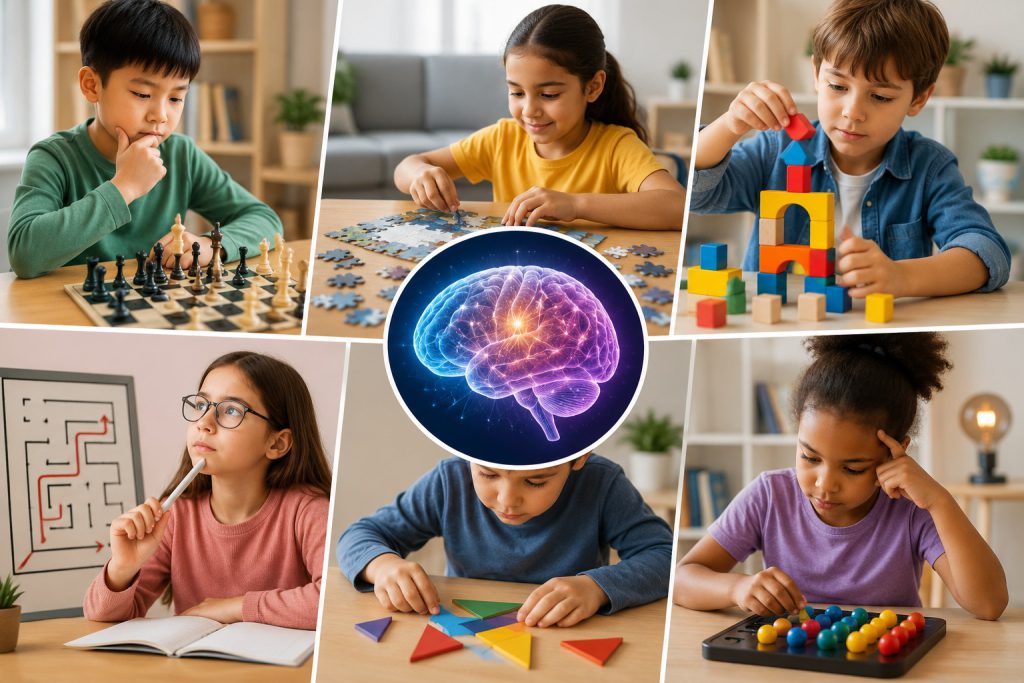
Games such as Chess, Checkers, Sudoku, and logic puzzles teach children to:
- Think several steps ahead
- Predict consequences
- Evaluate risks
- Adapt strategies
These are excellent critical thinking activities kids genuinely enjoy because learning happens naturally through play.
3. Brain Puzzles and Pattern Recognition
Crossword puzzles, tangrams, sequencing activities, visual reasoning exercises, and riddles improve analytical thinking.
These enjoyable brain exercises for kids strengthen neural pathways responsible for reasoning and flexible thinking.
4. Real-Life Decision Making
Invite children into everyday decisions.
Ask questions like:
- Which grocery option gives better value?
- How should we organize today’s schedule?
- What’s another solution if Plan A doesn’t work?
These simple conversations become powerful activities to build thinking skills while helping children gain confidence in their own judgment.
5. Memory and Visualization Exercises
Visualization is one of the strongest predictors of advanced cognitive ability.
Activities involving visualization include:
- Story sequencing
- Image recall
- Object observation games
- Number visualization
You can also explore these Memory improvement activities for children
Why Abacus Training Is Different
Unlike traditional math tutoring, abacus learning trains multiple areas of the brain simultaneously.
Children don’t simply calculate—they visualize, imagine, remember, analyze, and solve.
During advanced learning stages, physical beads disappear entirely, and children begin visualizing a mental abacus to perform rapid calculations.
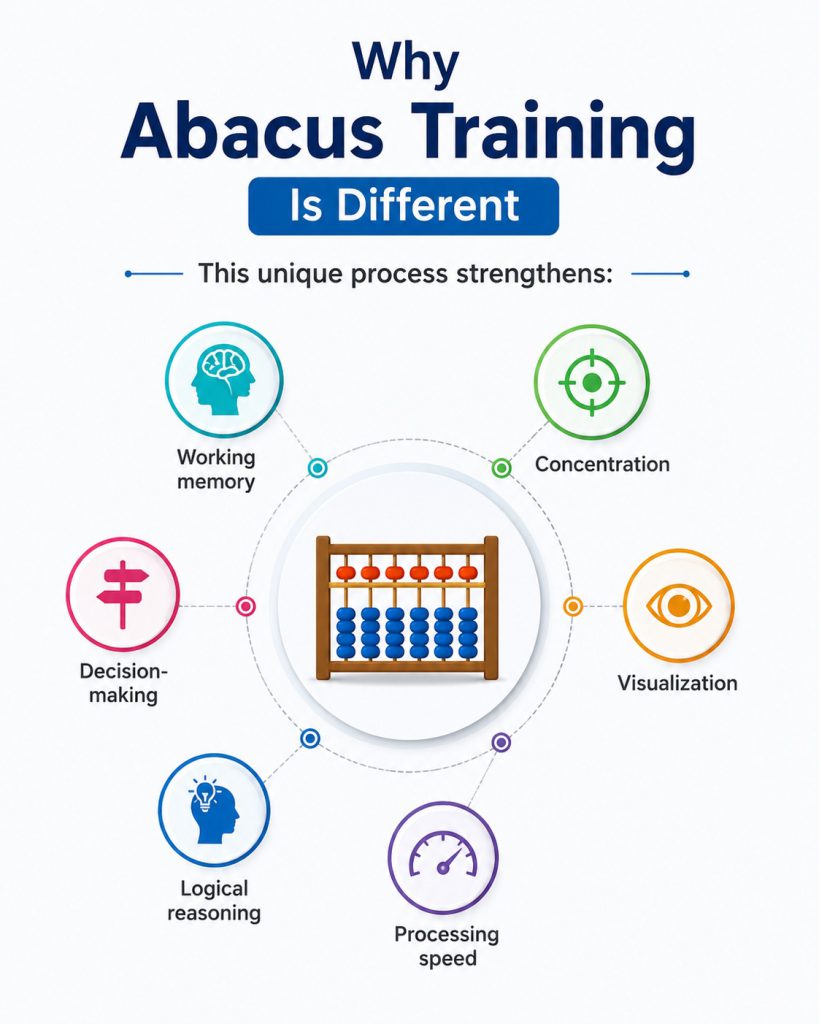
This unique process strengthens:
- Working memory
- Concentration
- Visualization
- Processing speed
- Logical reasoning
- Decision-making
It is precisely why so many educators recognize the benefits of abacus in schools as a powerful cognitive development tool rather than just another math class.
Read more in this guide on How abacus improves strategic thinking in children.
Beyond Mathematics: Building Everyday Problem Solvers
Problem-solving isn’t limited to mathematics.
Children use these skills when they:
- Resolve disagreements
- Plan projects
- Understand stories
- Build with blocks
- Code simple programs
- Conduct science experiments
Strong problem-solving skills children develop early often translate into improved academic performance across all subjects.
This explains why more educators are exploring abacus for schools as part of holistic brain development initiatives.
The Role of Mental Math Worksheets
Practice remains essential.
Parents often supplement classroom learning using abacus mental math worksheets and mental math worksheets for kids to reinforce visualization and reasoning at home.
The key isn’t repetition alone—it’s encouraging children to explain how they reached their answers.
That simple conversation activates deeper cognitive processing than simply marking answers correct or incorrect.
Why Parents Search for Abacus Programs
Many parents searching online for abacus for kids near me aren’t simply looking for better math grades.
They’re looking for programs that help children:
- Think independently
- Stay focused longer
- Learn faster
- Solve unfamiliar problems confidently
- Develop lifelong cognitive abilities
When children enjoy the learning process, they naturally become more curious, confident, and motivated. Learn How abacus develops thinking skills in children and teaches them how to think the right way.
Small Daily Habits Create Lifelong Thinkers
Developing stronger thinking skills doesn’t require hours of extra study.
Even 15–20 minutes of purposeful brain training each day can create meaningful improvements over time.
Some simple daily habits include:
- Reading together
- Solving logic puzzles
- Mental math practice
- Asking “why” questions
- Encouraging multiple solutions
- Playing memory games
Consistency matters far more than intensity.
Over months and years, these habits help children develop curiosity, confidence, resilience, and independent thinking that extends far beyond academics.
Give Your Child the Gift of Thinking
Every parent wants their child to succeed—not only in school but throughout life.
Strong thinkers become confident learners, creative innovators, and capable problem-solvers who adapt to changing challenges with ease. At UCMAS, our cognitive development programs are designed to nurture these essential skills through structured brain training that goes far beyond mathematics.
Experience how UCMAS can help your child develop sharper focus, stronger reasoning, and greater confidence through proven brain development techniques.
Book your free information session with UCMAS today!
FAQs
Activities such as mental math, logic puzzles, chess, storytelling, memory games, and strategy-based exercises encourage children to analyze information and make thoughtful decisions. Programs like abacus training combine several of these cognitive skills into one structured learning experience.
Parents can encourage children to solve everyday challenges, ask open-ended questions, play strategy games, and discuss different solutions instead of giving immediate answers. Consistent practice helps children become more independent thinkers.
Critical thinking begins developing during the preschool years as children start asking questions, making choices, and recognizing patterns. Structured cognitive activities during early childhood can strengthen these abilities significantly.
Abacus training develops visualization, concentration, memory, and logical reasoning simultaneously. Children learn to analyze numbers mentally, improving both calculation speed and problem-solving confidence.
Memorization focuses on recalling information, while critical thinking involves analyzing, evaluating, and applying knowledge to new situations. Children who develop critical thinking become more adaptable and confident learners.
Yes. Regular cognitive exercises strengthen attention, working memory, processing speed, and reasoning, all of which support better learning across subjects including math, science, and reading.
Most experts recommend short, consistent sessions rather than long study periods. Around 15–20 minutes daily, combined with structured weekly learning, can produce meaningful cognitive improvements over time.
Children with stronger thinking skills often ask more thoughtful questions, solve unfamiliar problems independently, explain their reasoning clearly, and show greater confidence when facing new challenges. These improvements typically become noticeable through consistent brain training and practice.