


In the early years of schooling, marks often become the most visible indicator of a child’s progress. Report cards, rankings, and comparisons can easily overshadow deeper questions: Is my child enjoying learning? Are they confident enough to try? Do they believe in their own abilities
While marks may reflect short-term academic performance, confidence shapes a child’s long-term relationship with learning. Especially in the early school years, confidence matters more than marks because it determines how your child learns, not just what they score.
In this blog, let’s understand your child’s learning psyche step by step. We’ll explore why early school years form the foundation of learning behaviour, why test marks often take priority in assessment, why confidence plays a far more powerful role in growth, and how the teaching ecosystem can nurture confident learners.
Early School Years: The Foundation of Learning Behaviour
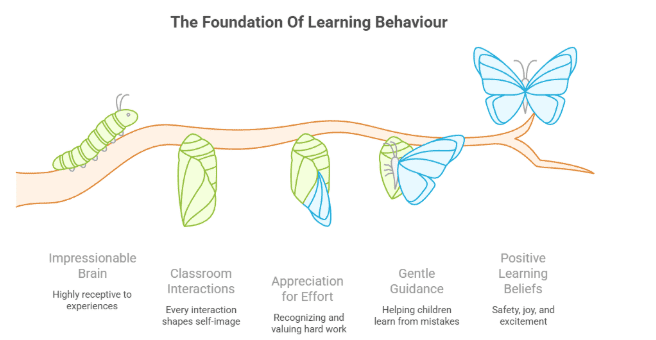
The early school years, typically between the ages of three and eight, are not just about learning letters, numbers, or basic concepts. They are about shaping how a child sees themselves as a learner.
During this phase, children are forming silent beliefs about their abilities. They begin to decide whether they are “good” at something, whether mistakes are acceptable, and whether learning feels exciting or intimidating.
At this age, the brain is highly impressionable. Every classroom interaction, every word of encouragement, and every reaction to a mistake contributes to the child’s self-image. If children repeatedly experience appreciation for effort and gentle guidance through errors, they begin to associate learning with safety and joy. If they experience comparison, pressure, or criticism, they may slowly associate learning with fear or performance anxiety.
This early learning confidence matters more than we often realize. The habits and attitudes formed in early primary years can influence how a child approaches academics even a decade later. A confident learner in Grade 1 is more likely to remain an engaged learner in Grade 10.
Why Do Test Marks Take Priority in Assessing Performance?
Marks dominate educational conversations largely because they are visible and quantifiable. A number on a report card provides a quick summary of performance. For parents and teachers managing multiple responsibilities, marks feel like a clear indicator of progress. They simplify assessment into something tangible.
However, marks only capture performance at a specific moment. They reflect how well a child answered questions on a particular day under particular conditions. In early schooling, especially, children are still developing writing speed, comprehension maturity, emotional regulation, and test-taking comfort. A child’s score may reflect their mood that day or their comfort with the exam format rather than their true understanding.
What Marks Typically Measure
1. Memory and Recall
Marks often reflect how well a child can remember and reproduce information that was taught. This may include recalling definitions, formulas, spellings, or procedures. While memory is an important skill, it represents only one aspect of learning.
2. Speed and Accuracy
In timed assessments, children who can process information quickly and respond accurately tend to score higher. However, speed does not always indicate depth of understanding. Some children think more carefully and may take longer to arrive at well-reasoned answers.
3. Familiarity with Testing Formats
Children who are comfortable with structured exams, written responses, or multiple-choice patterns may perform better. Sometimes marks reflect how confident a child feels during a test rather than how deeply they understand the subject.
4. Ability to Follow Instructions
Tests often reward students who carefully follow directions and present answers in the expected format. A child who misunderstands instructions may lose marks despite knowing the concept.
What Marks Often Do Not Measure
1. Creativity
Marks rarely capture a child’s ability to think imaginatively, explore new ideas, or approach problems in unique ways.
2. Problem-Solving Ability
Real-world problem-solving involves persistence, experimentation, and flexible thinking. Standard tests may not fully reflect these abilities.
3. Emotional Intelligence
Skills such as empathy, teamwork, emotional regulation, and social understanding are essential for overall development but are not graded in typical exams.
4. Willingness to Try
A child who attempts challenging questions with courage demonstrates a growth mindset, even if the answer is not perfect. This effort often goes unmeasured.
5. Curiosity and Independent Thinking
Children who ask questions, explore beyond the syllabus, or think critically may not always receive higher marks, even though these traits predict long-term success.
The Importance of Confidence in Learning
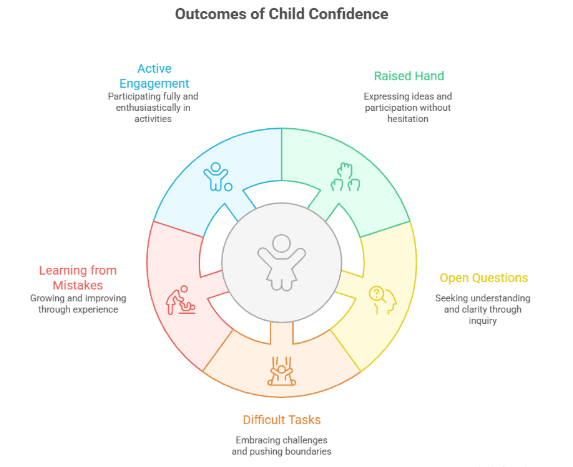
Confidence is not about knowing everything. It is about believing that one can try, learn, and improve. In early school years, this belief becomes the engine that drives all future learning. When children feel confident, they are more willing to raise their hands, attempt difficult problems, and ask questions when confused. They are less afraid of being wrong because they trust that mistakes are part of growth.
This mindset transforms academic development. Confident children engage actively with lessons instead of passively memorising. They absorb concepts more deeply because they participate fully. They approach tests with calmer minds, which often results in better performance anyway. Most importantly, they develop resilience. When they encounter setbacks, the student mindset is more likely to think, “I’ll try again,” rather than “I’m not good at this.”
On the other hand, children who rely solely on marks for validation may begin to fear mistakes. They may avoid challenging tasks to protect their scores. Over time, this fear can limit growth far more than any low grade ever could. Confidence, therefore, becomes a far more reliable predictor of long-term success than early academic scores.
Learning Driven by Confidence | Learning Driven Only by Marks |
Children participate actively in class discussions and express their ideas freely. | Children may hesitate to speak unless they are sure their answer is correct. |
They retain concepts better because they engage deeply with the material. | They may memorise information for exams without fully understanding it. |
Children approach tests with calmness and lower anxiety levels. | They often experience stress and pressure during exams. |
They see mistakes as opportunities to improve. | They fear failure because mistakes affect their scores. |
Children willingly attempt challenging tasks and new concepts. | They may avoid difficult tasks to protect their marks. |
Their self-worth is based on effort and growth. | Their self-worth becomes tied to grades and comparison. |
Academic improvement happens naturally over time. | Performance may fluctuate based on pressure and fear. |
How the Teaching Ecosystem Can Promote Confident Learning
A child does not build confidence alone. It grows through the support they receive from teachers, parents, classmates, and the way they are taught. When a classroom allows children to ask questions freely, without fear of being wrong, they feel safe to speak up. When teachers appreciate effort, practice, and improvement instead of only perfect answers, children understand that learning is about trying and growing, not about being flawless.
The environment at home matters just as much. When parents move the focus away from “How many marks did you score?” and instead ask, “What did you learn today?” or “What was interesting in class?” they show their child that learning is more important than scoring. This reduces pressure and helps children enjoy the learning process. Additionally, parents can introduce child confidence development learning methods that build confidence and understanding, thereby promoting effective learning.
Learning Methods That Build Confidence
The way children learn plays a powerful role in shaping how they feel about themselves. When learning methods encourage child confidence development, participation, exploration, and skill development, confidence grows naturally. Let’s learn more about such methods.
Hands-On Learning
Young children grasp concepts better when they can interact with them physically. When learning involves movement, visual tools, or step-by-step engagement, understanding becomes clearer and more meaningful. Instead of passively listening, children actively participate in the learning process.
For example, when mathematical concepts are taught using visual aids like an abacus or worksheets, children can see and experience how numbers work. This makes abstract ideas concrete. A child who understands deeply feels more confident about attempting similar tasks independently.
Hands-on Learning V.S Memorization: Which learning method works? Read more.
Play-Based Learning
Play allows children to experiment without fear. In playful environments, mistakes do not feel threatening; they feel like part of the activity. Children try different approaches, explore possibilities, and learn through discovery.
When learning feels enjoyable rather than pressured, children become more willing to participate. Structured yet engaging programs that include interactive activities and mental challenges help maintain this balance. The experience becomes stimulating instead of stressful, allowing confidence to build steadily.
Experiential Learning
Confidence strengthens when children see the results of their own progress. Experiential learning connects knowledge with real outcomes. When children can observe their improvement, solving faster, concentrating longer, remembering better, they begin to believe in their abilities.

Skill-development programs that follow a step-by-step progression allow children to experience measurable growth. Over time, they recognize their own improvement. This realisation, “I can do this now,” is a powerful confidence booster.
Skill-Based Learning
Beyond subject knowledge, children need strong mental skills such as concentration, memory, visualization, and logical thinking. When these core abilities improve, academic tasks feel easier and less intimidating.
Programs such as UCMAS are designed to strengthen cognitive skills often have a positive ripple effect. As children advance in skill-based learning, their focus sharpens, memory retention and mental agility improve.
Raise the Confidence Bar with UCMAS
Confidence is not built overnight; it is developed through consistent practice, guided learning, and small, repeated successes. UCMAS nurtures this journey by strengthening core mental skills such as concentration, visualization, memory, and analytical thinking in a structured and supportive environment.
As children progress, they don’t just become faster at calculations; they become more focused, more self-assured, and more willing to take on challenges. The confidence they gain extends beyond academics into classroom participation, public speaking, and everyday decision-making. If you want your child to grow not only as a high performer but as a confident learner ready for life, now is the perfect time to begin. Enroll your child in UCMAS today and watch their confidence unfold.
FAQs
Absolutely. A child may be developing critical thinking, communication skills, resilience, and curiosity, all of which indicate healthy progress even if marks are average.
Signs may include fear of making mistakes, hesitation to answer in class, anxiety before tests, avoidance of new tasks, or excessive worry about marks.
Parents can start by praising effort instead of results, asking about what was learned rather than what was scored, and encouraging children to view mistakes as learning opportunities.
Yes. Programs that strengthen concentration, memory, and problem-solving skills while providing steady progress and encouragement can significantly improve a child’s confidence, along with academic ability.
5. Why do children sometimes lose confidence despite scoring well?
When children feel pressure to constantly maintain high marks, they may begin to fear mistakes. Over time, this pressure can reduce self-belief, making them anxious about performance rather than excited about learning.
The key is to value both, but prioritize mindset in the early years. Celebrate improvement, effort, and understanding first. When confidence is strong, academic results tend to improve naturally.